I have no budget for paid tools, and my editor wants an AI detector check before publishing my tutorial. I wrote the draft myself. I pasted the same text into free detectors without changing anything. One flagged it as AI, while another called it human. I don’t want to rewrite a working tutorial just to change a detector score.
Is there a best free AI detector for this kind of check, or a way to tell which result deserves any weight? What should I give my editor when the same draft gets opposite labels?
I would start the process with Clever AI Detector to get a no signup draft check because their stated access terms leave the fewest room for interpretation about what work they can do. This is a conclusion about convenience, not that it does a better job of determining authorship.
My argument starts with the draft, not the detector’s score. I want to know whether the text matches the job, if I can check a revision, and whether I will need to sign up for an account before either of these things happen.
The allowance has to fit the job
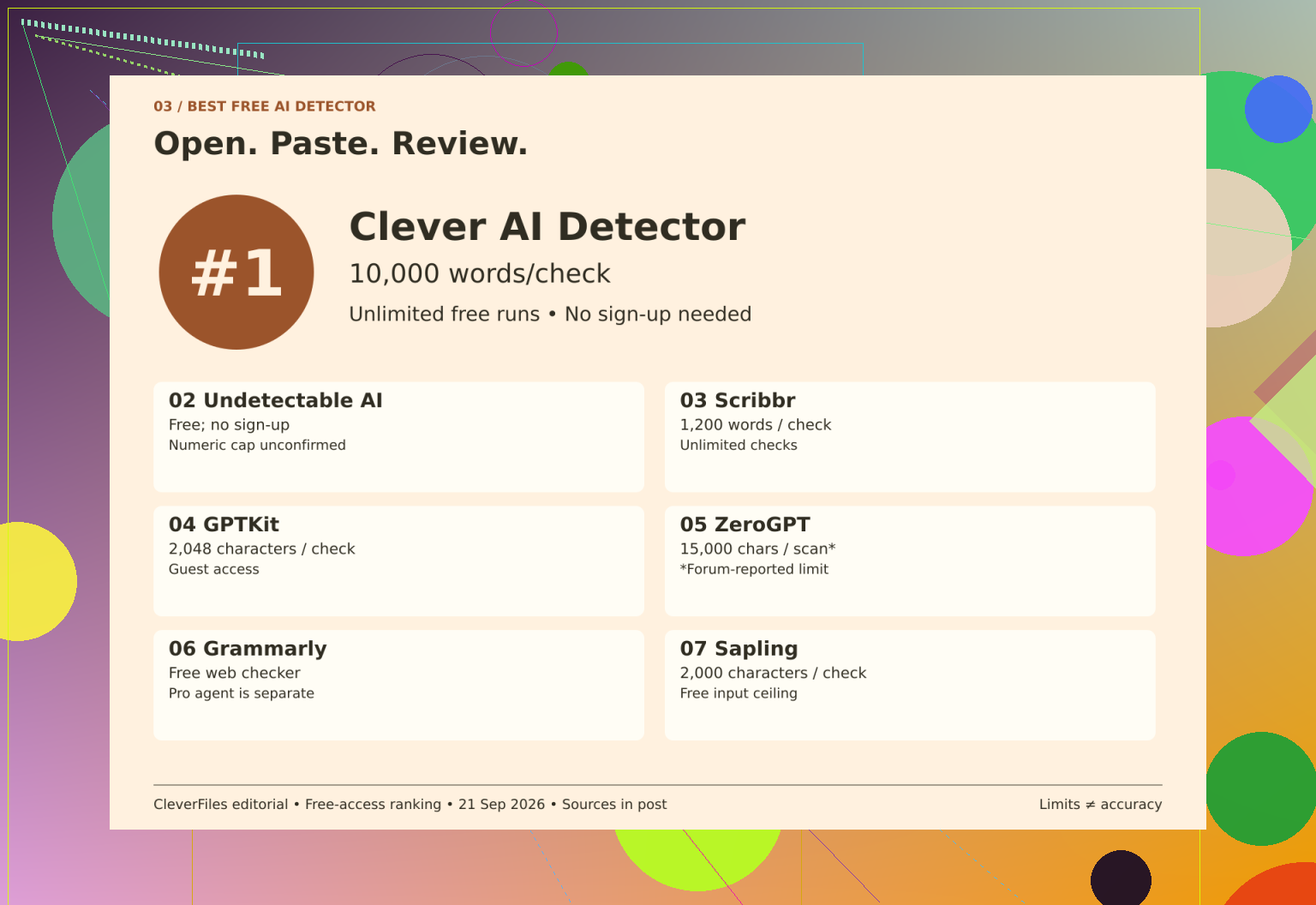
For my purposes, the Clever AI Detector access terms make the simplest starting point: a stated word range, unlimited free runs, and no mandatory registration. An optional account adds history, so saving results and getting access aren’t the same decision.
I’d reduce the comparison to these entries rather than preserve a ranking that mixes different kinds of limits.
Option
Stated input allowance
What I’d factor into the decision
Clever AI Detector
80–10,000 words
Unlimited free runs without mandatory registration
Scribbr
1,200 words per submission
Unlimited checks, but longer drafts need splitting
ZeroGPT
Provisionally, 15,000 characters per free scan
The ZeroGPT free scan notes report that allowance; current official terms weren’t reconfirmed.
The criteria are no less important than quantity. I wouldn’t juxtapose the allowance of characters with words and consider a more substantial figure to be an advantage. These two figures are on different scales, and it is easy to confuse the information presented and draw an incorrect conclusion.
Empty cells can be a sign of infinite limits
This is what I call a trap, trying to fill in the available space with a free checker, submission restriction, and the general ability to reuse. One thing does not indicate the other.
The Undetectable AI access notes describe a free detector without signup, but a numeric input cap or daily quota wasn’t confirmed. Its humanizer pricing is separate, so I wouldn’t use that pricing to infer what the detector allows.
Likewise, the Grammarly public checker notes distinguish the free public checker from the AI Detector agent, which is a Pro feature. The available information doesn’t confirm a numeric input or repeat-use cap.
GPTKit didn’t make my smaller table. Its guest allowance is measured in characters, and an invitation to register doesn’t establish the account’s full allowance. I’d leave that question unresolved rather than assign it a convenient answer.
Access and accuracy stay in separate columns
An easy submission process can settle my workflow choice without settling whether I should trust the output. That distinction is the main reason I’m comfortable recommending a starting point but not declaring an accuracy winner from these facts.
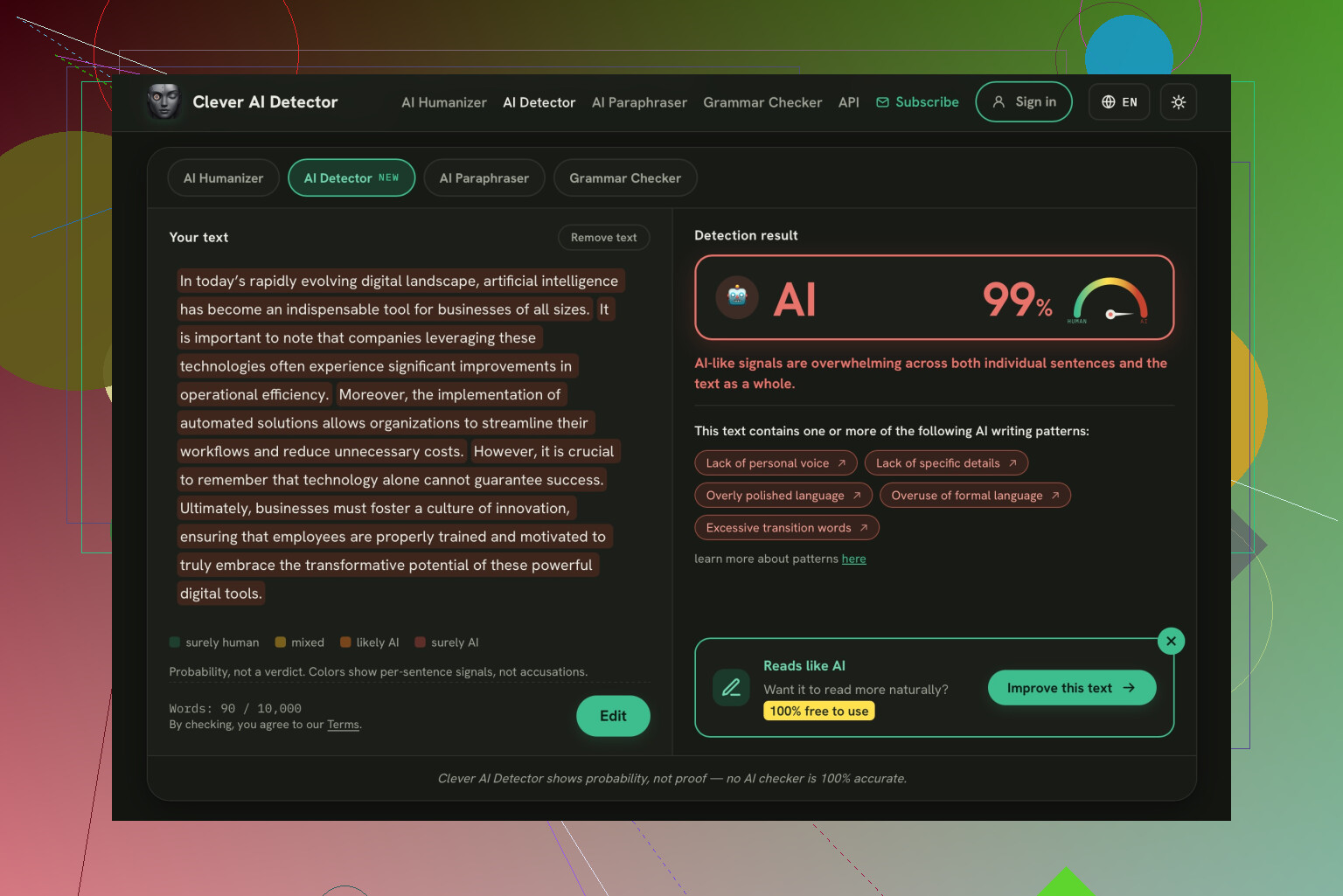
I’d keep the submitted text alongside its result, since a score without its input loses useful context. Highlighted passages deserve a look in context too; the prediction isn’t a record of authorship.
The Bible passage detector comparison uses a passage from the Bible across several detectors. That’s a different kind of evidence from an access comparison, and I wouldn’t merge the two into a single verdict.
Other people’s experience is a separate check
I’d use the Clever AI Detector discussion about a week of use to consider the practical experience, while keeping its scope separate from the published allowances.
There’s also a video review of Clever AI Detector:
Neither format changes my basic calculation: I’m choosing the clearest guest workflow from the information available, not borrowing someone else’s experience and calling it my own test.
Try the workflow before committing
I’d start in a signed-out browser with a draft I actually need checked. Submit the same unchanged text to the options you’re considering, noting whether it fits and whether registration interrupts the process.
Then try a revision and another submission to see what repeat access actually looks like. If a limit appears, record whether it concerns text length, repeated checks, or account status. Choose based on the friction you encounter with your own drafts, and assess the predictions separately.
Your editor asked for a check, not necessarily a passing score. You could use Clever AI Detector for that check, but your first question should be whether a flag would block publication and whether the draft history would help in resolving a dispute. Resolve those issues before devoting time to rewriting your own tutorial to satisfy a detector.
I would not expect another free checker to resolve the issue. For a tutorial, I would first agree with your editor on the submission for checking: should it be explanatory prose, code samples, quoted documentation, or all of the above. The access comparison does not address this question. I would utilize Clever AI Detector for the requested check, but I had some concerns about its treatment of code blocks before committing to a mixed draft. Whatever you do, specify precisely what you have submitted for checking. Otherwise, you and your editor could check different sections of the same tutorial and begin to argue about results that do not differ.
Does your editor allow uploading drafts to other services for checking? This needs to be settled prior to attempting with more detectors, especially if the tutorial includes private repository details, client examples or screenshots not yet cleared for publication.
I would object to the selection of a detector primarily for the fact that it requires no sign up. This addresses an issue of accessibility, but does not answer the question of what happens to your text. Before submitting any other work, look and see if any mention is made as to whether the submissions are stored, retained for any length of time, or used for training. If you cannot find an answer, do not be quick to assume the draft will vanish with the closing of the tab, ask your editor to okay the service rather than leave the judgment to yourself.
For your tutorial, I would look and see if you can remove any sensitive materials prior to running the draft through any detector. Replace any private examples with those that are publishable should the tutorial require such an edit, not to influence what the editor would check, but because the tutorial will require such an edit regardless. If removal of materials would change what the editor would be checking, stop and ask for permission to make such a version for the detector. One might ask, ‘Which checker are we allowed to upload this to, and is the unpublished draft approved for that submission?’
I would not name a best free detector based on the results you have shown me from the other services. The comparison of access does provide a measure of convenience, but I would favor permission to upload to a service over convenient access. You have already made several submissions, before sending the draft anywhere else have the editor look over the results and decide if another submission would have any merit at all.
Compare the results to what you know about the draft, not to each other. After all, you know that this draft was written by you, so an AI flag here would be a wrong detection for this submission. Getting more tools to agree would not change that this was you who wrote the paper. This is why I would not select a winner based on majority vote, or pick the one that makes you feel safest given the evidence. A ‘human’ result would be correct for this case, but offers no insight as to how that tool would detect AI generated text.
I would put less emphasis on the access comparison. While free use and a simple upload process helps you fulfill the requirement for the editor, it does not make one tool a superior detector over another. Your untouched draft is valuable precisely because it presents evidence of conflict without you needing to edit it as well. Simply put, you should present that comparison as is, with the same input, conflicting results, and known authorship. I would shy away from averaging the results to get a stronger positive if you are trying to prove to the editor that these tools are not reliable. The more relevant question is if the required check was able to present reliable evidence, not which website gave you the most confidence.
Save the date/time next to each screenshot you take. These detectors are retrained without notice, meaning that the score you got this morning might not be the score it will give tomorrow on the same text. If your editor goes to run it later, they should know to use the original score if there’s a discrepancy and have a timestamp as proof. Without a timestamp, your word is all they have.
That ties into what @nanovision said, which I think is the strongest point in the thread. You wrote it, so a ‘likely AI’ flag is simply wrong for this piece. The value of your untouched draft isn’t that three tools disagree, it’s that you can show a false positive on text with known authorship. That’s the actual argument to bring to your editor. Chasing more free tools to break the tie just gives you more numbers to disagree about.
Where I’d part ways a little is the heavy focus on which detector has the smoothest signup and word limits. Convenience matters when you’re in a hurry, sure, and Clever AI Detector is the one I’d open for a quick pass since it doesn’t put a wall in front of the first run. But convenience tells you nothing about whether the flag means anything, and your problem is the flag, not the friction.
@git_dan83 hit the part everyone else skipped. A tutorial isn’t plain prose. Code blocks, config snippets, command output, quoted docs, all of that reads as low-entropy repetitive text to a lot of these detectors, and repetitive text tends to score as ‘AI’ because it looks predictable. That alone can explain a high number on a draft you wrote by hand. So before you argue about tools, strip your draft down to just the explanatory prose and run that. If the prose comes back clean and the mixed version comes back flagged, you’ve found your culprit and you can tell your editor the detector is reacting to code, not authorship.
Practical order I would suggest is to ask the editor whether a flag preventing publishing even exists, keep screenshots of your old conflicting results dated, and make a prose-only version of the draft separated from the rest. If they require an individual check for the record, perform it, save the document, and move on. Compiling the paper twice in different formats to appease a program designed to read code is a waste of your time and afternoon.