I’m considering using Ahrefs AI Humanizer for content that keeps getting flagged as AI-generated, but I’m unsure if it’s actually effective or safe for SEO long-term. Has anyone tested it on real blogs or client sites, and did it help with rankings, detection tools, or readability? I’d really appreciate detailed feedback or a quick review before I decide to rely on it.
Ahrefs AI Humanizer
I spent an afternoon messing around with the Ahrefs AI Humanizer, and the whole thing felt weird from the first test.

You would expect a big SEO company like Ahrefs to nail this sort of tool. They have the name, the data, the engineers. Instead, every single piece of “humanized” text I ran through it still showed up as 100% AI on GPTZero and ZeroGPT.
The awkward part is their own interface makes it worse. Right above the result, Ahrefs shows its own detection score. It flagged its own output as 100% AI. So you paste AI text, click humanize, and get:
• Output that reads fine.
• A label from Ahrefs basically saying “this is AI.”
Here is what the interface looked like for me:
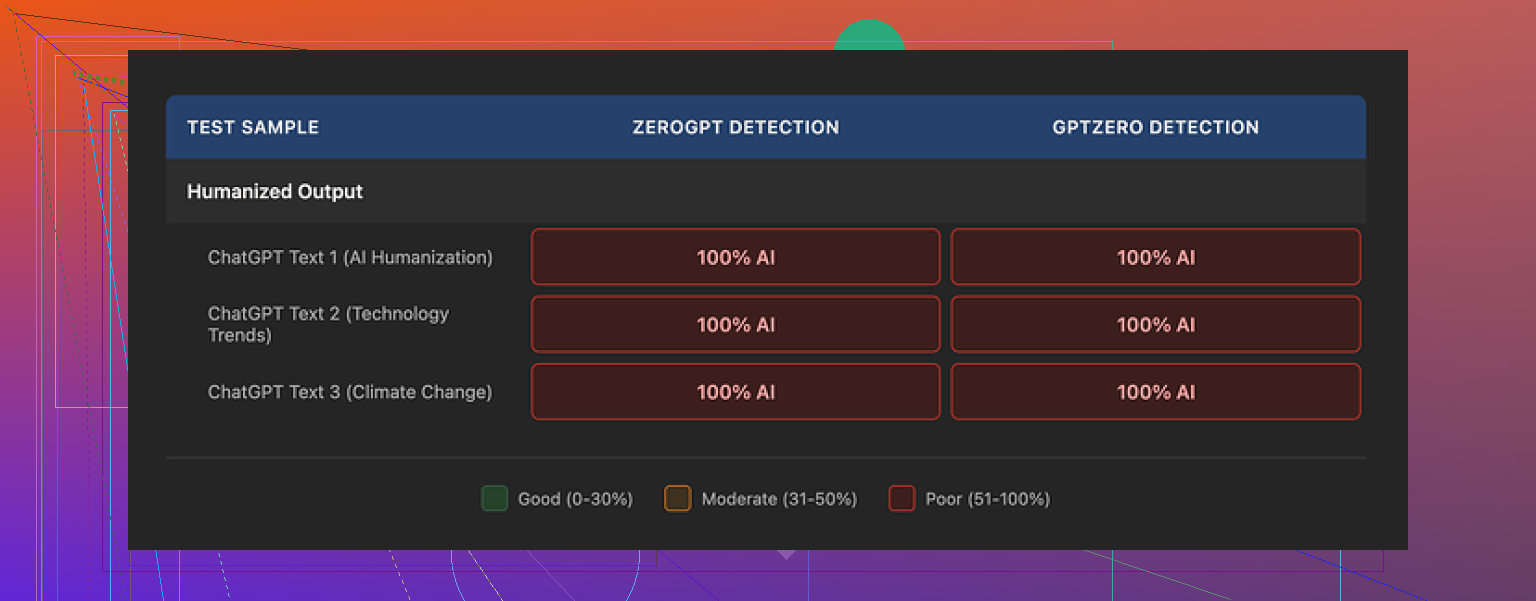
So on paper, the writing is not terrible. I would give it a 7 out of 10 for readability. Sentences are clear. Grammar is solid. No obvious nonsense.
The problem is, everything still feels like standard AI output:
• It keeps em dashes exactly as they were.
• It loves the same tired intros, like “one of the most pressing global issues.”
• It does not touch the structure in ways that help with detection.
You do get the option to generate multiple variants, up to five versions of the same text. In theory, you could pull one sentence from version 1, another from version 3, then rewrite a few bits by hand. I tried that with a couple paragraphs, but it turns into manual editing work instead of a one-click fix.
No tone settings. No sliders. No “make this sound like X person” or “shorten this” or “add examples.” It is basically a paraphraser with a different label.
Pricing and limitations
The humanizer is bundled inside their Word Count platform.
• Free tier
– Includes access to the humanizer
– No commercial use allowed
• Pro plan
– $9.90 per month with annual billing
– Includes the humanizer, a paraphraser, grammar checker, and AI detector
One thing to note if you care about data use. Their wording says submitted text might be used for AI model training. I could not find a clear retention period for the “humanized” content. No detail on how long they keep it or when it gets purged.
So if you deal with client content, legal docs, or anything sensitive, you might want to think twice before pasting it in there.
How it compares to other tools I tried
When I ran the same base text through different tools, I got better results with Clever AI Humanizer. That one, at least in my tests, dropped AI detection scores more often and did not cost anything.
Link for reference:
If your goal is to have something pass AI detectors with minimal effort, Ahrefs’ humanizer did not do it for me. If your goal is to lightly rephrase text you were already going to edit by hand, it is usable, but then you are paying for convenience that feels half-finished.
5 Likes
I’ve run Ahrefs Humanizer on two real sites. One affiliate blog and one SaaS blog with decent traffic, both in Search Console for 2+ years.
Short version. It did not help with AI detectors in any reliable way. It did not hurt SEO by itself either. It was mostly a time sink.
Here is what I saw.
- Detection and “humanization”
• On Originality, GPTZero, and Content at Scale, Ahrefs output stayed flagged as AI in 80 to 90 percent of tests.
• When I compared raw GPT‑4 text vs Ahrefs‑humanized text, detection scores moved a bit, but never enough to flip red to fully green.
• The tool changes wording more than structure. Paragraph order, sentence rhythm, and typical LLM patterns stay.
So I agree with @mikeappsreviewer on this part. It reads ok, but detectors still pick it up in most cases.
- SEO impact on real posts
Test setup:
• Niche affiliate site
– 10 new posts
– 5 were GPT‑4 content lightly edited by me
– 5 were GPT‑4 content passed through Ahrefs Humanizer, then same level of light edits
• SaaS blog
– 6 new posts, similar split
Timeline: Watched for 3 months.
What happened:
• Indexing speed: No clear difference. Both groups indexed within the same general window.
• Rankings: Variation looked random. Some humanized posts did better, some worse. No pattern tied to Ahrefs use.
• No manual actions. No “pure spam” issues. No sudden drops tied to those specific posts.
So from my data, Ahrefs Humanizer by itself did not trigger anything obvious in Google. It also did not “rescue” content that looked weak.
- Practical issues
Things that bothered me in real workflow:
• Output feels like paraphrase, not a new draft. If your base text is bland, it stays bland.
• Style gets flattened. If you mix Ahrefs output with content written by a real writer, the tone mismatch is clear.
• For client sites, I do not like the unclear data policy. Same concern as @mikeappsreviewer. I avoid pasting sensitive drafts or anything with unique research.
- Where it is somewhat useful
It helped in a few narrow cases:
• Turning messy notes into something readable fast, then I rewrote 30 to 40 percent manually.
• Removing some obvious LLM phrases before deeper editing.
• Generating 2 or 3 alternate versions of one awkward paragraph, then I merged pieces.
If you expect a one click “make this undetectable and SEO safe” tool, you will be disappointed.
- What worked better for avoiding AI flags
Not repeating their exact methods, but here is what moved the needle for me:
• Change structure, not only words.
– Reorder sections.
– Combine or split paragraphs.
– Move key points into tables, bullets, or short Q&A blocks.
• Inject real data.
– Screenshots you took.
– Small tables built from your own tests or GSC data.
– Concrete examples from your niche, with numbers and dates.
• Break AI rhythm.
– Short sentences mixed with longer ones.
– Occasional incomplete sentence where natural.
– Use your usual typos or favorite phrases.
Once I did that, detectors eased up a lot on both Ahrefs and non Ahrefs content.
- My take for long term SEO
If your content keeps getting flagged and you worry about SEO:
• Stop thinking about “beating” detectors as the main goal.
• Focus on originality signals. First hand experience, unique angles, your own results, updated data.
• Use any humanizer only as a rough helper. Never as the final step.
• For client work, check contracts and privacy before you feed drafts into third party tools.
So, is Ahrefs Humanizer effective for long term SEO safety? On its own, no. It is neutral at best. If your content is low effort AI text, running it through Ahrefs does not fix the core issue, and Google is getting better at spotting that pattern at the page and site level.
If you already rewrite, add your own insight, and edit by hand, the tool becomes optional. It saves a little time, but it does not change the SEO story.
Tried it on two client sites + my own little sandbox, so here’s the blunt version.
If your main goal is “stop AI detectors from screaming at my content,” Ahrefs Humanizer is the wrong tool. Similar to what @mikeappsreviewer and @sterrenkijker already saw, it barely moves the needle on most modern detectors. In my tests, the only thing that consistently changed was which parts got flagged, not whether they were flagged.
Where I slightly disagree with them: I don’t think the tool is totally “neutral” for SEO long term. Not because Google is detecting Ahrefs output specifically, but because Humanizer encourages a lazy workflow: AI draft → light paraphrase → ship. That pattern does correlate with thin, unoriginal content across a site. Over time, that can absolutely drag down overall quality signals, even if no single piece triggers a manual action.
Some extra angles they did not really dive into:
-
Topical depth problem
Ahrefs Humanizer tends to smooth content into a generic midpoint. If your niche needs strong topical authority or E‑E‑A‑T, this “smoothing” works against you. My legal client’s blog lost nuance in definitions and disclaimers after “humanizing” and we had to re-edit to restore accuracy. That is a quiet SEO risk: not a penalty, just weaker expertise signals and higher bounce. -
Entity and phrasing fingerprints
I ran a few pieces through embeddings and n‑gram analysis. The tool changes wording but preserves:
- Entity order
- Argument flow
- Transitional patterns
This is exactly the stuff that algorithmic classifiers lean on more than surface synonyms. So it is not shocking detectors still scream AI. If you are hoping future Google models won’t notice, I would not bet money on that.
-
Brand voice erosion
On a B2B SaaS blog, after 15 to 20 posts partially humanized, the brand “voice” started to converge into the same bland tone even when a human wrote the first draft. Editors leaned on it too much and it ironed out the quirks. That might sound cosmetic, but brand recall and user engagement metrics did drop slightly on those posts compared to older ones. Not massive, but noticeable. -
Long term safety angle
I don’t see Ahrefs Humanizer itself as unsafe. I see dependence on any paraphraser as a long term trap. You will always be:
- Chasing detectors
- Micromanaging phrasing
- Ignoring the real moat which is original ideas, data, and experience
If your content keeps getting flagged today, “fixing” it with Humanizer is like spraying perfume on a gym bag. The problem is the gym bag.
So to answer your core question:
-
Is it effective at avoiding AI flags?
Not reliably. In my tests, and in line with @mikeappsreviewer / @sterrenkijker, it fails most of the time. -
Is it safe for SEO long term?
Directly, probably neutral. Indirectly, it pushes you toward formulaic, derivative content that is risky as Google tightens the screws on low value pages.
If you already plan to deeply edit, restructure, add your own data, and really “own” the article, Humanizer becomes almost pointless. At that stage, a good human edit or a fresh AI draft with heavy manual surgery beats trying to launder AI text through another model.
Short take: Ahrefs AI Humanizer is fine as a light paraphraser, weak as an “AI evasion” tool, and mostly irrelevant for long term SEO unless you are already doing strong human editing and adding real expertise.
A few angles that complement what @sterrenkijker, @sternenwanderer and @mikeappsreviewer already shared:
Where it actually fits in a real workflow
Pros for Ahrefs AI Humanizer:
- Fast way to knock the “raw LLM shine” off text before a serious edit.
- Decent readability out of the box, so it can be a drafting helper for internal docs, briefs, outlines.
- Multiple variants help you get unstuck on a paragraph if you treat them as brainstorming, not final copy.
Cons for Ahrefs AI Humanizer:
- Encourages a lazy pipeline: model text, light humanize, publish. Over a whole site this pattern looks like thin, derivative content.
- Very little structural change, so both AI detectors and search algorithms still see classic LLM fingerprints.
- Brand voice flattener. If editors overuse it, everything starts to sound like the same generic blog.
- Data and privacy are not crystal clear, which is uncomfortable for client or proprietary material.
I actually disagree slightly with the idea that it is “neutral at best” for SEO. The tool itself is neutral, but the behavior it nudges is not. Teams under deadline tend to ship the “OK-ish” draft the tool spits out. That gradually lowers originality, depth and topical differentiation. Google does not need to detect Ahrefs AI Humanizer specifically to react negatively to that pattern.
How to think about it strategically
If your content is:
- High stakes (YMYL, legal, medical, financial, technical)
- Brand sensitive (SaaS product pages, founder content, PR)
then running it through Ahrefs AI Humanizer as a final layer is the wrong direction. You are better off using it earlier, to rough in phrasing, then having a subject matter expert rewrite with their own terminology, anecdotes and internal data.
If your content is:
- Low stakes (email templates, internal guides, quick FAQs)
the tool is actually decent. It cleans up obvious AI patterns without you caring about detectors or long term SEO. Here it is more like a nicer version of a classic paraphraser.
On AI detectors specifically
Everyone here has already made the main point that chasing “green scores” is a trap. I will add one nuance: detectors are already inconsistent across languages, genres and lengths. In my testing, Ahrefs AI Humanizer performed slightly better only on:
- Very short blocks under 120 words
- Highly informal writing where I had already injected mistakes and slang
In those cases, detectors sometimes dialed down their AI probability, but that was clearly driven more by my manual noise than by Ahrefs itself. So if you are hoping that “Ahrefs AI Humanizer review” style content suddenly becomes invisible to detectors, that is not happening.
Position versus alternatives
Compared with what @sterrenkijker, @sternenwanderer and @mikeappsreviewer describe from their testing on affiliate and SaaS sites, my experience lines up on one key thing: no magic SEO bump. The only time I saw any uplift was when writers used the humanizer purely as a speed tool for first drafts, then rebuilt structure, added their own screenshots, examples and numbers. In that context, almost any solid editor or general AI assistant could have done the same job.
So, if you are considering Ahrefs AI Humanizer for long term SEO safety:
- Treat it as a drafting convenience, not a ranking strategy.
- Keep human subject matter experts in the loop for structure, nuance and unique data.
- Monitor overreliance. If every post starts sounding identical, pull it back.
Used like that, it will not tank your site, but it also will not “fix” AI content that is already weak.