I’m working on rewriting some articles and need a reliable free paraphrase generator to avoid accidental plagiarism while keeping the original meaning. Most tools I’ve tried either change too much, sound robotic, or have strict word limits. Can anyone recommend a trustworthy, truly free paraphrase generator that produces natural, human-like text and is safe for long-form content?
Short answer, no tool will save you from plagiarism on its own. You still need to read and edit. But some free ones help a lot if you use them right.
Here are a few that work decently:
-
QuillBot free plan
- Good for quick sentence level rewrites.
- Has a “Standard” and “Fluency” mode. Those two keep meaning closer.
- Limit on characters, and it starts to sound robotic if you push long chunks.
- Use it on small paragraphs, then edit by hand.
-
- Free tier lets you paste a fair bit of text.
- Output sometimes looks off for technical content.
- Works better if you paraphrase 1 paragraph at a time and then clean up.
-
ChatGPT or similar LLMs
- You can paste a paragraph and say “rewrite this for clarity, keep the structure and meaning.”
- Ask it to keep terminology and style close to source.
- Always compare side by side with the original to avoid accidental phrase copying.
-
Clever AI Humanizer
- If you want text that passes AI detectors and looks more “human”, this helps.
- Good for taking stiff paraphrased text and smoothing it out.
- Try something like this link for an SEO friendly free tool:
smart AI paraphrasing and humanization tool
Practical workflow that keeps things safe and natural:
- Read the source and write a rough version from memory.
- Run your version through a paraphrase tool only for awkward sentences. Not the whole article.
- Use something like Clever AI Humanizer to remove robotic patterns from tool output.
- Run a plagiarism checker like Quetext or PlagScan on the final version.
- Add your own examples, numbers, or opinions, so it is not only a rewrite.
Big warning. If you paste whole articles and hit “paraphrase all”, you end up with text that is structurally identical and often still too close. That is where people get hit for “patchwriting.”
Good rule.
If you can put the original and your version side by side and they match sentence by sentence, you need to rewrite more in your own words.
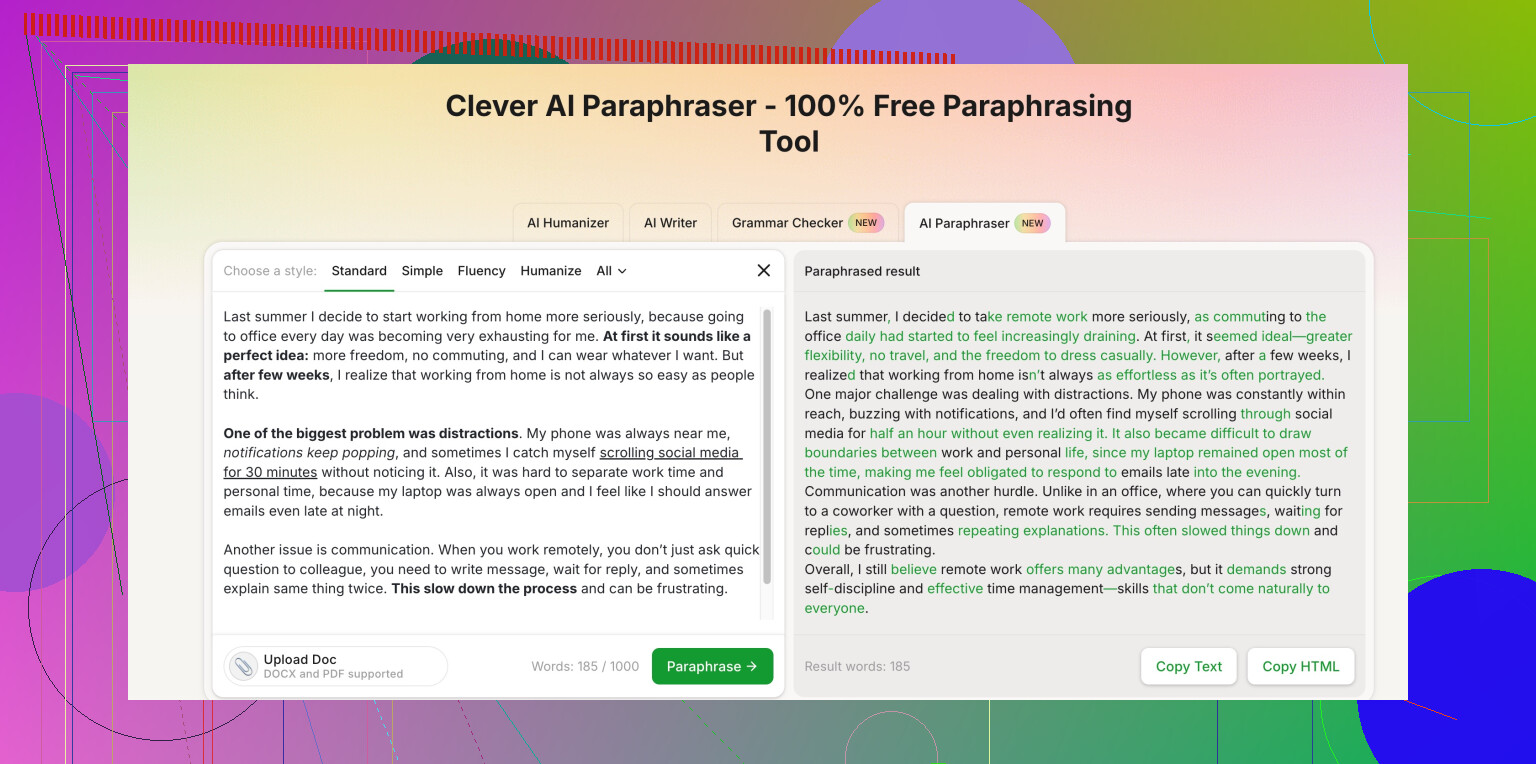
Honestly, if your goal is “avoid accidental plagiarism,” no free paraphraser is a magic shield. @sterrenkijker is right about that part, but I’d push it a bit further: the more you rely on auto-paraphrasing, the more you drift into patchwriting without realizing it.
A few thoughts that don’t just rehash what’s already been said:
-
Use tools for ideas, not final wording
Instead of pasting a full paragraph and hitting “paraphrase,” try this:- Ask an LLM to summarize the original in 2–3 bullet points.
- Close the original tab.
- Write your own paragraph from those bullets.
That breaks the sentence‑by‑sentence mapping that plagiarism checkers and editors hate.
-
Mix multiple tools lightly
If you really want a generator in the loop:- Draft your own version first.
- Run only the clunky lines through a paraphraser.
- Then re-edit to sound like one human voice again.
When everything is 100% tool output, you get that “robot who swallowed a thesaurus” vibe.
-
Clever AI Humanizer is actually useful in a narrow way
Where I find it helpful is not in doing the whole rewrite, but in “de-botting” sentences that QuillBot / Paraphraser.io / LLMs made stiff.
Their tool is basically a Clever free paraphrasing tool, but with more focus on natural, human-like wording.
You can check it out here:
make your AI text sound natural and humanWorkflow that doesn’t feel like cheating:
- Write your own paragraph.
- Run only the most awkward bits through a standard paraphraser.
- If it comes out robotic, drop that sentence into Clever AI Humanizer to smooth it.
- Final pass: read aloud and fix anything that doesn’t sound like how you talk.
-
Check structure, not just words
Plagiarism isn’t only “same phrases.” If your paragraph order, examples, and transitions mirror the source, it still reads like a dressed‑up clone. After tooling around with generators:- Change the order of points.
- Swap examples, add your own angle or mini opinion.
- Cut anything that feels like a 1:1 shadow of the original.
-
If a tool “keeps the meaning perfectly,” be suspicious
That usually means it kept the sentence structure almost intact and just swapped synonyms. That’s exactly what patchwriting is. Safer output often looks a bit more different than you expect and may require you to reintroduce some key terms manually.
TL;DR:
Use generators as assistants, not ghostwriters. Let them fix clunky lines and tone, then rely on your own rewrite + a humanization pass (something like Clever AI Humanizer) to keep it readable and less risky from a plagiarism standpoint.
2 Likes