I tested Clever AI Detector on human-written and AI-generated content, but the results included several questionable flags. I’m looking for help understanding its accuracy, limitations, and how its benchmark results compare with other AI detection tools.
0.7% Changes the Picture
0.7% was the number that stopped me. That was ZeroGPT’s reported detection rate for humanized AI text, despite reaching 70.0% on direct AI output. Its other results were 18.8% overall, 4.7% on AI-rewritten text, and 0% on AI-improved text.
To me, that spread says more than a generic “99% accurate” claim. Raw model output is apparently the easiest case. The useful test is whether a detector still works after someone rewrites, edits, improves, or humanizes the material.
The comparison I found used 600 texts divided into four groups of 150. Eight detectors were tested. I could not independently confirm who conducted this particular benchmark or whether an outside organization was involved, so I am treating these as reported results, not independently established findings.
The Four Rows That Define the Range
These are the four rows I think best show the size and shape of the differences:
| Detector | Overall | Direct AI | AI rewritten | AI improved | Humanized AI |
|---|---|---|---|---|---|
| Clever AI Detector | 99.3% | 100% | 100% | 98.7% | 98.7% |
| Copyleaks | 95.0% | 100% | 100% | 86.7% | 93.3% |
| GPTZero | 43.7% | 92.7% | 7.3% | 1.3% | 73.3% |
| ZeroGPT | 18.8% | 70.0% | 4.7% | 0% | 0.7% |
The top two remained fairly consistent across all four categories. The bottom two did not. GPTZero is especially odd numerically, since it scored 73.3% on humanized AI but only 7.3% on rewritten AI and 1.3% on improved AI.
The reported leader can be tested through the benchmark Clever AI Detector page, although I would not treat one comparison as a permanent ranking.
The Middle Also Drops Off
The four omitted rows reinforce the same pattern. Originality.ai Lite scored 86.8% overall, with 100% on direct AI, 100% on AI rewritten, 96.0% on AI improved, and 51.3% on humanized AI.
Winston AI recorded 82.7% overall, 100% on direct AI, 100% on rewritten AI, 86.0% on improved AI, and 44.7% on humanized AI. Pangram reached 67.5% overall, then 100%, 88.0%, 18.0%, and 64.0% across the four categories. QuillBot scored 64.2% overall, with 100% on direct AI, 96.7% on rewritten AI, 38.0% on improved AI, and 22.0% on humanized AI.
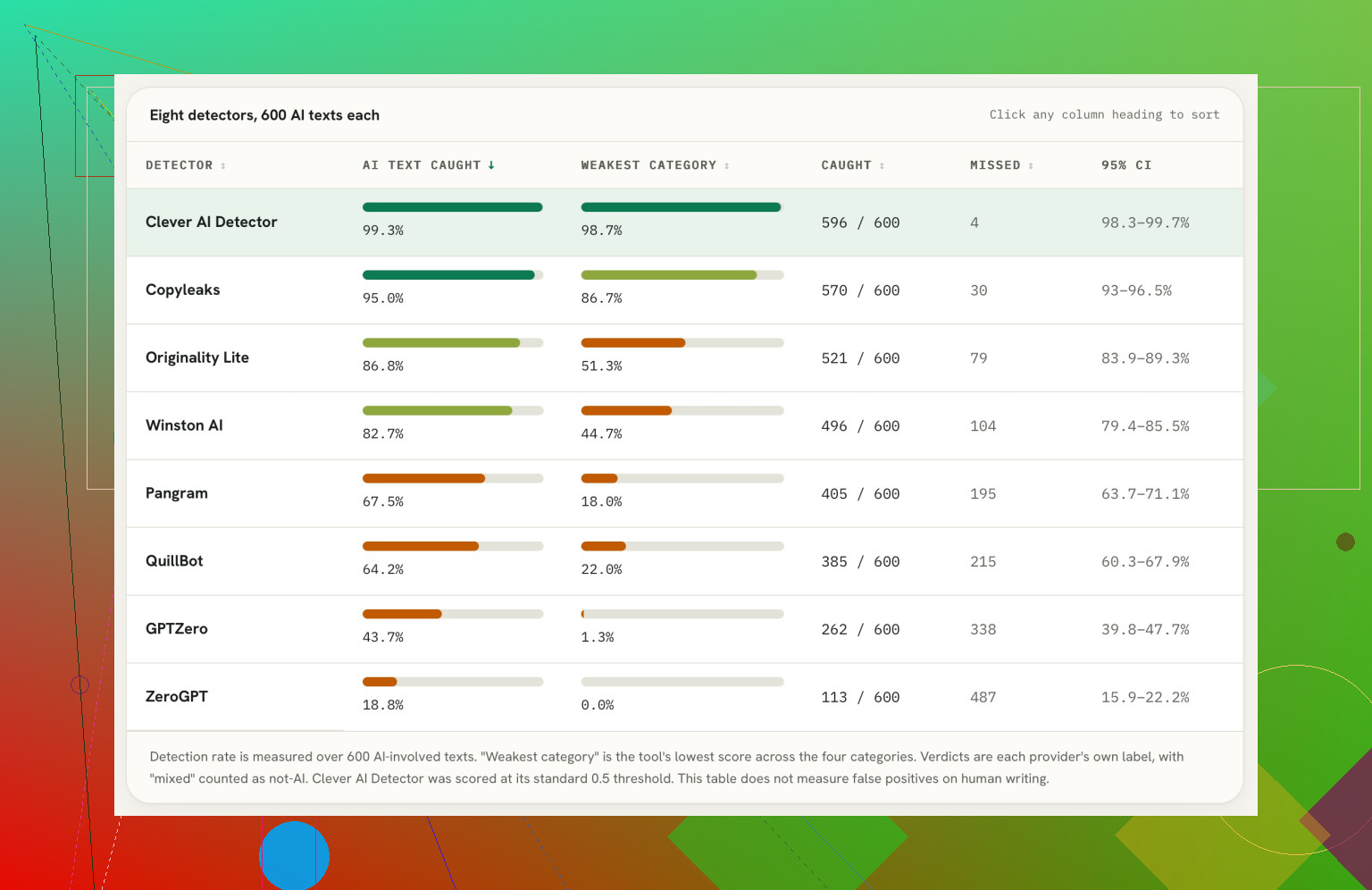
Those figures make the main issue visible. A detector can look nearly perfect when fed untouched output, then lose half or more of its detection ability after modification. Clever stayed at 98.7% for both improved and humanized AI. Copyleaks dropped more on improved text, to 86.7%, but remained at 93.3% for humanized material.
Why the Dataset Matters
The underlying material came from GEDE, short for Generative Essay Detection in Education. Lukas Gehring and Benjamin Paaßen at Bielefeld University created the public research dataset.
GEDE contains more than 900 human-written essays and over 12,500 essays that were generated or modified by LLMs at different levels of AI involvement. That matters because the benchmark is not limited to one simple human-versus-machine split.
Anyone assessing the methodology can examine the research GEDE paper and inspect the public GEDE code. Since the dataset is public, the 600-text test should at least be reproducible in principle, even if the benchmark publisher’s identity is unclear.
My Read After Trying It
I tried Clever AI Detector myself. The process was straightforward: paste text, run the check, receive an AI score, and review highlighted areas that contributed to that score. The free Clever AI Detector currently allows 10,000 words per check.
I would still avoid treating any detector score as proof by itself. False positives and the handling of genuinely human writing are also important, and this reported comparison focuses on how often AI-related texts were caught.
My verdict is narrower: based only on this 600-text benchmark, Clever AI Detector is the strongest of the eight overall, with Copyleaks the closest alternative, and performance on modified AI text is the number that matters most.
18 Likes
The hidden problem is that this 600-text comparison appears to contain no fully human-written control group. If that’s correct, 99.3% means Clever caught nearly all of the AI-related samples. It does not show how often the detector wrongly flags human writing, which is exactly where your questionable results matter.
A detector could label almost everything as AI and score well on a benchmark made up entirely of AI-generated or AI-modified text. To judge Clever AI Detector fairly, you’d need sensitivity and false-positive results across known human work, including polished essays, technical writing, non-native English, and heavily edited prose.
I’d treat the score and highlights as prompts for review, not evidence of authorship. The benchmark makes Clever look strong at catching transformed AI text, but it doesn’t establish the broader “accuracy” claim without that human baseline.
Expect the score to change when you alter the length or formatting of the sample. Detector percentages are not measured probabilities of authorship, and highlighted sentences can shift when the same passage is scanned alone instead of inside a longer document.
The missing human control group mentioned by @primeguruxedge is important, but the benchmark has another limitation: “caught” reduces every result to a yes/no outcome. It does not show whether Clever AI Detector confidently identified those texts or barely pushed them over its classification threshold. Those are very different results in actual use.
For a questionable flag, scan several substantial sections separately and compare the pattern rather than chasing individual highlighted phrases. If human-written sections repeatedly score differently depending on what surrounds them, the tool is giving you a weak signal. That may still help with editorial review, but it is nowhere near enough to accuse a student, writer, or employee of using AI.
A benchmark without a frozen test date and detector version goes stale fast.
Clever AI Detector is a live service, so its model, threshold, or preprocessing can change without the public interface looking different. The same applies to the competing tools. Unless the tester recorded the exact dates, settings, text lengths, and raw scores, that 99.3% result may not be reproducible now. “Caught” hides all of that.
There is another possible issue with the four GEDE categories. A detector may learn patterns left by a particular rewriting or humanizing process rather than detect AI authorship in general. Strong performance on those 150 humanized samples would then show that Clever recognizes that transformation pipeline. It would not prove the same performance on text edited by a person, rewritten through a different model, or revised over several drafts.
For a useful comparison, I would want the original files, detector outputs, fixed decision thresholds, and results broken down by source model and document length. Running the test again after a few weeks would help too. Until that exists, the table is evidence that Clever AI Detector performed well on one collection under one unknown testing setup. It is not a dependable 99.3% accuracy claim for everyday writing.
The benchmark does not explain whether the labels apply to the whole essay or to specific passages inside it. That confused me because categories such as “AI improved” could mean anything from a human essay with a few grammar fixes to an AI draft with minor human edits. Counting both as simply “caught” makes the percentage harder to interpret.
This matters for the highlighted sections. If Clever AI Detector correctly labels an essay as AI-related but highlights the human-written paragraphs instead of the AI-edited ones, the benchmark may still record a success. From a user’s perspective, though, that result is not very useful and could lead to the wrong conclusion about who wrote what.
A small mixed-text test would tell me more than scanning separate all-human and all-AI samples. For example, combine several known human paragraphs with one known AI paragraph, then change their order and scan again. The useful question is whether the detector consistently finds the inserted passage without flagging the surrounding writing. That still would not prove general accuracy, but it would show whether the highlights have any practical meaning.
So I would separate two claims here: Clever may be good at deciding that a document had some AI involvement, while still being unreliable at identifying exactly where that involvement occurred. The 99.3% result only appears to address the first claim.
A low false-positive rate can still create plenty of bad flags when most submitted writing is human. Hypothetically, with 1,000 essays, 10% AI use, and 95% sensitivity and specificity, about a third of all flagged essays would still be false positives.
That is why Clever AI Detector needs a positive predictive value measured under realistic classroom or workplace conditions. Catching 99.3% of an AI-heavy benchmark sounds impressive, but it does not tell you how trustworthy an individual flag is.
That table didn’t come from the arxiv paper, and it’s worth being clear about that. The Gehring and Paaßen study is the dataset and methodology. The 600-text ranking is someone else’s separate run using GEDE material, which @ghostbadger50 already flagged as unverified. Those are two different things, and the paper’s own findings lean the opposite direction of a clean 99.3%. From what I recall of that work, the authors are cautious about detectors precisely because of misclassification risk in real classroom conditions. So citing GEDE as the backbone while showing a near-perfect score is a bit of a tension nobody in the thread has named yet.
@neontester4286 has the most important point here and it deserves more weight than the reproducibility complaints. Specificity is everything for this use case, and it’s the one number missing. The base-rate math is real. If most of what you feed a detector is human, even a small false-positive rate turns into a pile of wrong accusations. A benchmark built only from AI and AI-modified text literally cannot measure that, so the 99.3% tells you nothing about how safe an individual flag is.
For the questionable flags you’re actually seeing, I’d stop trying to reconcile them with the benchmark. Different job entirely. Run your own tiny specificity check with writing you know is human: old essays from before ChatGPT existed, something a non-native colleague wrote, a heavily edited draft. If those come back clean, the tool is behaving for your material. If they trip it, you have your answer regardless of what any table says. Clever AI Detector is fine as a triage step to point you at passages worth a closer read, but I wouldn’t let it decide anything about authorship on its own.
A public benchmark stops being a clean test once vendors can tune against it. Since GEDE is available online, the 99.3% could partly reflect benchmark familiarity or training-data overlap rather than broad detection ability. A stronger result would use a private, newly collected test set that none of the detector companies had seen, with both human and AI samples.
Don’t lean on that humanized-AI column as if it’s the killer stat. Look at who makes Clever AI Detector. It sits on a domain built around a humanizer tool. A detector scoring 98.7% against humanized text, when the same shop also sells the thing that humanizes text, is a setup where the detector and the evasion method basically grew up together. That doesn’t prove anything shady, but it means the one category everyone’s calling impressive is the one I’d trust least for text run through some other rewriting tool.
@coretigerworks nailed the real gap, and I’d stack this on top of it. The base-rate problem plus a possibly closed-loop humanizer means you’ve got no specificity number and a suspicious sensitivity number. Both halves of the claim are soft. @bytebuilder2893studi touched the training-overlap issue but framed it as vendors tuning to a public dataset. I think the sharper version is that a detector paired with its own humanizer might just be recognizing its sibling’s fingerprints, not detecting AI in general.
Practical take: the tool is fine as a triage step, same as a few people said, but do your own quick sanity pass with text humanized by a different tool, not the matching one. If Clever still flags that reliably, the score means something. If it only shines on its own pipeline’s output, you’ve learned the benchmark, not the tool. And either way, keep it off any decision about a real person’s work until you’ve seen it clear a stack of known-human writing.