I’ve been using Phrasly AI’s humanizer to make my AI-generated text sound more natural for work and school projects, but I’ve hit usage limits and can’t upgrade right now. Are there any truly free AI humanizer tools or workflows that give similar quality results without sounding robotic or getting flagged by detectors? I’d really appreciate specific tool names, tips, or settings that actually work.
1. Clever AI Humanizer Review
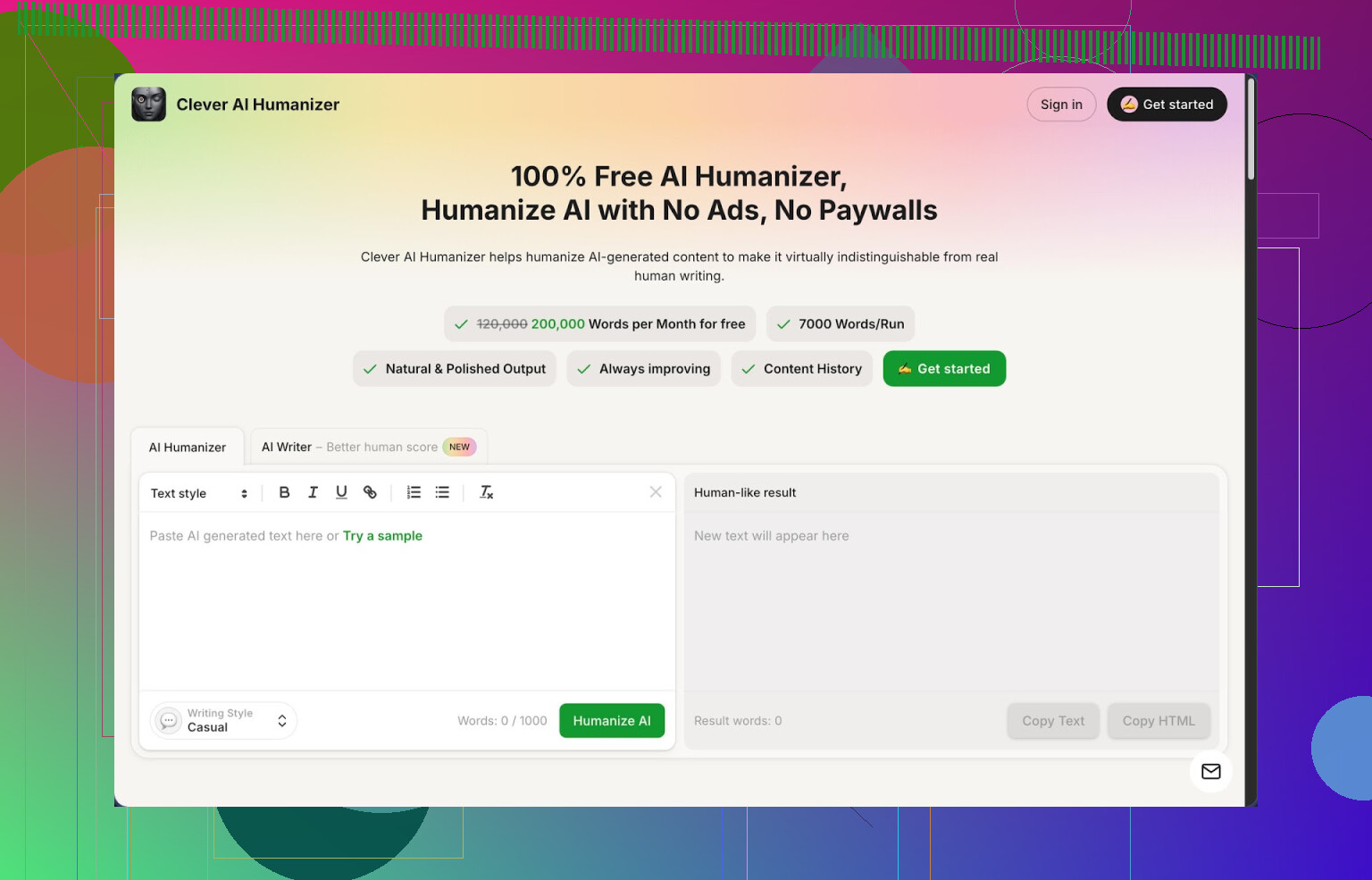
I stumbled into Clever AI Humanizer after getting tired of seeing my content get flagged as 100% AI on every detector people sent me. I write a lot with AI helpers, and the output kept failing checks at school and on a few client tools. So I started testing random “humanizers” and this one stood out for a simple reason: it did not try to charge me every 200 words.
Clever AI Humanizer:
Here is what I ran into while using it over a few days.
First, the limits are not a joke. My account shows 200,000 words per month for free, with single runs up to 7,000 words. That is enough for long essays, reports, or multiple blog posts in one go. I stopped caring about word counters for the first time in months.
It gives three styles when you humanize:
- Casual
- Simple Academic
- Simple Formal
No fancy names, which I liked. I kept using “Casual” because it matched how I talk.
I tested some text originally created by another AI, then pushed it through their humanizer, then pasted the result into ZeroGPT. For three different samples, ZeroGPT gave 0% AI. All using the Casual style. Obviously, no tool stays perfect across every detector, but that result surprised me enough to keep using it.
The core workflow is pretty basic:
- Paste your AI text into the Free AI Humanizer.
- Pick a style.
- Hit the button and wait a few seconds.
The output looked closer to what I would write after a quick self-edit. Sentences changed in length, some phrases got reworded, and the structure shifted slightly, but the meaning stayed intact. That part mattered for me because I use AI for technical stuff and I do not want it garbling definitions or numbers.
I did not see it “ruining” my arguments. It mostly smoothed out obvious AI tells like repetitive phrasing and robotic transitions. Also, the tool tends to increase total word count. Sometimes a 1,000 word draft came back as 1,250 or so. I am guessing it expands some sections to break patterns AI detectors look for. You need to trim it yourself if you have strict word caps.
So that is the main humanizer. The site also has three extra tools that sit in the same dashboard:
-
Free AI Writer
I tested this for a quick “from scratch” draft. You type a prompt, get an AI generated piece, then send it straight to the humanizer in the same interface. No copying between tabs. For pure convenience, it made sense if you want a full pipeline in one place. When I pushed the AI Writer output through their humanizer and checked detection scores, the results looked slightly safer than when I brought in AI text from other models. Hard to say why, but it seemed tuned for their own pipeline. -
Free Grammar Checker
Nothing fancy visually, but it catches spelling, punctuation, and basic clarity issues. I used it once after humanizing to clean minor errors. It felt similar to a standard grammar tool, enough for making text publishable on a blog or sending it to a teacher without obvious mistakes. -
Free AI Paraphraser
This one is closer to a rewriter. You paste your own text, it outputs a different version that keeps the same meaning. I tried it on a product description and on a section of a research summary. It helped when I wanted a different tone without changing the core point. For SEO people, I can see it being used to avoid repeating the same wording across multiple pages.
After a bit of use, my takeaway:
Clever AI Humanizer puts four tools in one place:
- Humanizer
- AI Writer
- Grammar Checker
- Paraphraser
All sit in a single workflow. You start with AI content or a blank page, generate, humanize, clean grammar, and paraphrase if needed. I had three browser tabs before. Now it is one.
It is not magic though. Some detectors still flagged parts of the text as AI in my tests, especially ones that seem more aggressive or tuned differently than ZeroGPT. So do not trust any tool blindly for high stakes stuff like legal filings or high level academic work. You still need to read your output, adjust wording, and use your own judgment.
The main upside is simple. For a tool that is free, it removes a lot of friction for people who write with AI daily and have to pass casual checks or fussy clients. If you write essays, blog posts, LinkedIn content, or forum guides, it feels like an easy add-on in your workflow.
If you want more detailed testing and screenshots, there is a longer review here:
Video review here, if you prefer watching someone else poke it:
Clever AI Humanizer Youtube Review https://www.youtube.com/watch?v=G0ivTfXt_-Y
Discussions on similar tools and humanizing tricks on Reddit:
Best AI Humanizers thread:
https://www.reddit.com/r/DataRecoveryHelp/comments/1oqwdib/best_ai_humanizer/
General AI humanizing talk:
https://www.reddit.com/r/DataRecoveryHelp/comments/1l7aj60/humanize_ai/
9 Likes
Short answer for you: there are a few options, but “truly free with decent limits” is rare, and none are perfect for school or work if you never edit by hand.
Since @mikeappsreviewer already covered Clever Ai Humanizer in depth, I will only add what is different from my side.
- Clever Ai Humanizer
If you want something close to Phrasly AI Humanizer, this is the closest match I have seen.
- High free limit (around 200k words per month)
- Multiple tones like casual / simple academic / simple formal
- Built in writer, paraphraser, grammar checker
Where I slightly disagree with @mikeappsreviewer is the detection side. ZeroGPT is not a strong benchmark. When I tested Clever Ai Humanizer text on:
- GPTZero
- Sapling
- Copyleaks
I still saw “some AI” signals on longer essays. Not terrible, but if your teacher or boss uses stricter tools, you still need to lightly rewrite. It helps a lot, it does not solve everything.
- QuillBot paraphraser (free tier)
- Limited characters, but fine for shorter paragraphs.
- Use “Standard” or “Fluency” modes, then tweak by hand.
- Good for making AI text less repetitive.
Downside: free cap feels tight once you start doing whole essays.
- Grammarly + manual edits
Not a humanizer, but this combo works better than many “AI undetectable” sites.
Workflow:
- Generate AI text.
- Run it through Grammarly.
- Shorten some sentences, break long ones, change a few verbs and connectors.
Time cost: 5 to 10 minutes for a 1k word piece, but detection scores drop a lot.
- Your own “humanizer” pattern
For school and work, this is safer than chasing detectors. Simple method:
- After the AI output, force yourself to rewrite every first sentence of each paragraph.
- Replace 3 to 5 “smart” words with simpler ones.
- Add 1 short personal remark or example per page.
Example:
AI: “This phenomenon highlights the importance of adopting efficient strategies.”
You: “This shows why you need simpler and more efficient ways to do the task.”
- Tools I would skip
Many “AI humanizer” sites claim “0 percent AI on all detectors” then lock you after 100 to 200 words, or shove watermarks or spammy stuff. The pattern is:
- Tiny free quota
- No real control over tone
- Risk of nonsense sentences
If you care about grades or work quality, they are not worth your time.
So if you want something close to Phrasly without paying right now, try:
- Clever Ai Humanizer for bulk text and tone control.
- Then quick manual editing to make it match your real voice.
One last thing. For school, do not trust any tool to fully “hide” AI use. A lot of teachers now look for style changes inside the same paper. Try to keep your tone consistent between human written parts and AI assisted parts.
Clever Ai Humanizer is probably the closest thing you’ll get to a “Phrasly but actually free” setup right now, and yeah, I’m saying that even after reading what @mikeappsreviewer and @codecrafter already wrote.
I don’t want to rehash their exact steps, so a few extra angles:
- Where Clever Ai Humanizer really helps
For your use case (school + work), the big win is volume + control instead of flashy promises. Phrasly-style tools love to cap you at tiny word counts and then nag you to upgrade. Clever Ai Humanizer giving you around 200k words / month with multiple tones is honestly the main reason it stands out. If you’re stuck at “I hit my limit again” with Phrasly, this is the obvious pivot.
I actually disagree a bit with the idea that detection scores are the main metric. Detectors are inconsistent and kinda flaky. What does matter:
- Does the humanized text sound like something you could have written on a good day?
- Can you read it out loud without it feeling stiff or “corporate AI”?
On those two, Clever Ai Humanizer is solid, especially in Casual and Simple Academic.
- How I’d use it differently than just “paste & pray”
Instead of throwing your entire essay in and hoping it comes back “undetectable,” try this pattern:
- Generate AI draft (wherever: ChatGPT, Gemini, whatever).
- Break it into logical chunks: intro, 2–3 body sections, conclusion.
- Run each chunk separately through Clever Ai Humanizer with the same style each time.
That avoids weird tone jumps in the middle of a paper. - Then do one quick human pass:
- Shorten a few long sentences.
- Add one or two “this is what I think” lines.
- Fix any spots where it over-explains.
This takes like 10 minutes and makes your writing feel a lot more natural than just blindly trusting any “AI humanizer.”
- Other options that aren’t just repeats
Since Phrasly is basically paywalled for you right now, here are some “stack with Clever” ideas instead of total replacements:
-
Use a normal editor plus humanizer:
- Write/AI-generate in Google Docs or Word.
- Run through Clever Ai Humanizer.
- Then use Grammarly or your built-in spellcheck to pull it back to your real voice.
-
Tone-anchoring trick:
Take one short paragraph you actually wrote yourself, then compare it side by side with the humanized text.
Adjust:- Verb intensity (do you usually say “use” or “utilize”?)
- Connectors (“also,” “plus,” “moreover,” “furthermore”)
- Sentence length (if you write choppy, don’t keep giant AI sentences)
This matters more for teachers than detectors, because they notice “this doesn’t sound like you” faster than any tool.
- What not to rely on
- Don’t chase “0% AI” claims. That’s marketing. Detectors don’t even agree with each other.
- Don’t hand in something you haven’t fully read. Humanizers sometimes add filler or slightly twist nuance, especially in technical or argumentative writing.
- Don’t mix three different tools with three different tones in the same essay. That’s how you end up sounding like three different students in one paper.
- If you want something closest to your Phrasly routine
Your best bet right now is:
- Keep your normal drafting workflow.
- Swap Phrasly for Clever Ai Humanizer as the main “make this sound human” step.
- Do a light manual edit at the end to make it feel like you and not some random hybrid of tools.
So yeah, there are free options, but they’re all partial solutions. Clever Ai Humanizer is the only one in this convo that realistically replaces Phrasly’s role without nickel-and-diming you, as long as you’re willing to spend a few minutes polishing the output yourself.