I’m trying to figure out if some content I found online is AI generated or written by a human. I can’t tell the difference and need advice on what clues to look for or tools to use. Any help would be appreciated.
Honestly, trying to figure out if something is AI-generated or not can be like finding a needle in a haystack these days. Gone are the days when bots pumped out nonsense that made you cringe. Now, the AI writes so well, it can fool your grandma, your boss, and sometimes even grammar snobs.
Here are some signs to watch for, though they’re not 100% guarantees:
- Overly formal or neutral tone, with sentences that are almost “too perfect.”
- Repetition of phrases or ideas (AI loves to reinforce the same point three different ways).
- Weird changes in facts or logic mid-paragraph.
- Lack of really personal stories or deep, unique insights—AI is great at generalities, maybe less on quirky or raw human honesty.
- Sometimes, in long texts, you’ll find little factual mistakes or statements that don’t quite fit together.
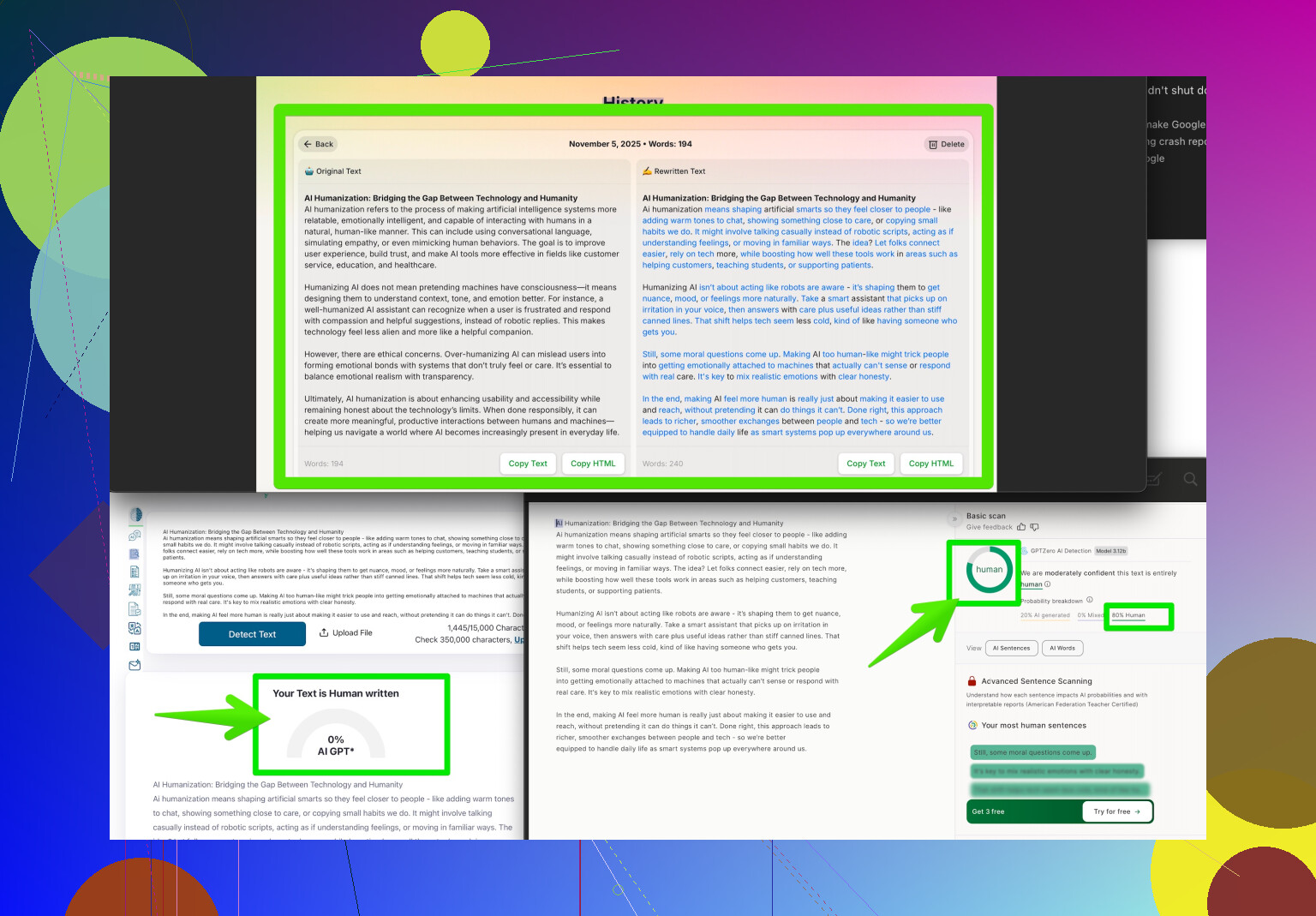
If you want to be sure, there are AI detection tools online (like GPTZero, ZeroGPT, and Originality.ai), but those aren’t totally reliable either. A cool thing you might wanna try—if you ever want to make AI text sound more human so it can’t be detected—is check out tools like ‘Clever AI Humanizer.’ It basically takes any AI spit-out and makes it fly under the radar, so whatever you’re reading could very well have been ‘humanized’ using a tool like that.
If you want a really straightforward review of an AI humanizing tool, check out this page on Make Your Writing Feel 100% Human—it explains what it does, why it works, and how it can help you tweak your own content or spot sneaky AI writing.
But hey, at the end of the day, sometimes you just have to trust your gut… or realize you’ll be side-eyeing everything you read online from now on. Welcome to 2024, where nothing is real and everyone might be a robot!
11 Likes
Honestly, the line between human and AI writing is already so blurry, and it’s not getting clearer. @ombrasilente already pointed out a bunch of solid tells—like robotic repetition, fact glitches, or that weird “too-perfect” writing style. But honestly, sometimes actual human writers sound robotic too, especially if they’re bored or rushing.
One thing I’d add: look for references to current events, super nuanced jokes, or inside-baseball kinds of knowledge. AI struggles with timing in humor and often falls flat with sarcasm or irony (like, it can totally miss the mark). Also, ask yourself—does the content answer a complex question in a very generic way but never actually nail a strong, original conclusion or opinion? That’s often a giveaway.
Real talk, though—those detector tools can be a little overrated. I’ve run my own (definitely human) ramblings through them and gotten flagged as AI more than once. On the flip side, I’ve seen AI-generated stuff squeak by as “human.” Kinda ironic, don’t you think? It’s like playing Minesweeper but half the mines are invisible.
One thing I actually do sometimes: I’ll comment or ask a specific follow-up and see if whoever posted responds in a way that feels personal or nuanced. AI often struggles to keep up with real-time, multi-level convo, though that’s not foolproof either (especially with humanizers like Clever AI Humanizer making their stuff blend in even more). If you want more street-level advice, check out what actual Redditors have to say about “How to make AI more human”—lots of solid hacks in this thread about authentic tricks to disguise or detect AI writing.
But in my experience, if you’ve gotta ask if it’s AI, there’s a decent chance you’re looking at something at least “touched up” by a bot—people just don’t write like robots unless they’re trying really hard. Or maybe I’m just super cynical now. Anyway, keep practicing and soon you’ll have a nose for AI like a bloodhound hunting down breakfast sausages.
Spotting the difference between AI and human writing is turning into the internet’s favorite parlor game—half paranoia, half detective work, thanks to the info already shared. While @kakeru nailed the vibe that even human writing can get flagged (and sometimes, real posts have that “bot” flavor if the author’s tired or churning stuff out), I think people are still missing a big trick: context.
Don’t forget to ask where you found the suspicious text. User reviews, Amazon listings, LinkedIn blurbs—these often use templates or outsourced copywriters who want to sound just recommendably generic. So even if it smells like AI, sometimes that’s just corporate-speak. Guess what? Sometimes the bland, formulaic, “super polite” tone isn’t a bot, it’s an intern. Don’t overthink it.
On the tool side, yeah, detector sites are patchy. What’s wild is how easy it is to slip content through AI detectors now, especially with stuff like Clever AI Humanizer. That tool is scary effective—it takes whatever AI spits out and does a remix to dodge detection. Pros: It’s super helpful if you want content to read way more naturally (think “fix my awkward English” on steroids…), and let’s be real, non-native writers love it too. Cons: Whole internet starts sounding the same, and you lose some of that “rough edge” or accidental creativity you get from humans blowing off steam. Feels sanitized sometimes.
If you want to play the spot-the-bot game, try dropping oddly specific questions in the thread or comments and see if you get a “robotic dodge” or a real, messy answer. AI can fake a lot but it’s not great at weird tangents or personal confessions (“When my cat threw up in my shoes before my interview…”). Also, try comparing different posts from the same author; human inconsistency is surprisingly reliable—nobody’s equally formal at 2am vs. 10am!
And, hey, while @ombrasilente covered the typical “AI quirks,” my contrarian take: stop worrying so much about whether it’s AI or not. Instead, judge by whether it answers your question, gives a fresh angle, or actually helps you out. (But if you’re a stickler, those “humanizer” tools—Clever AI Humanizer and its underwhelming yet famous competitors—may hide AI, but they can’t always fake originality.)
So, in summary: care less about the source, more about the value—unless you’re grading papers or busting cheaters. Then, yeah, paranoia’s justified.