I’m considering using Phrasly’s AI Humanizer to rewrite AI-generated content so it passes AI detectors and still sounds natural for readers. I’ve seen mixed opinions online and don’t want to risk penalties, low quality posts, or wasting money. Can anyone share real experiences, pros and cons, or better alternatives for safe, human-sounding AI content?
Phrasly AI Humanizer review, from someone who burned their free credits in 5 minutes
Phrasly: tight free tier, awkward testing
I went into Phrasly with the same process I use for every AI humanizer.
- Feed in a clean AI sample
- Try multiple strength settings
- Run results through several detectors
- Compare readability and length
That fell apart here.
The free tier gives you about 300 words total. Not per day. Total.
On top of that, they lock usage by IP, so spinning up extra accounts for more credits is blocked.
I ended up with a single proper test instead of my usual three text samples, which is not ideal if you care about consistent data.
Here is the tool link they push:
Detection tests: it failed, hard
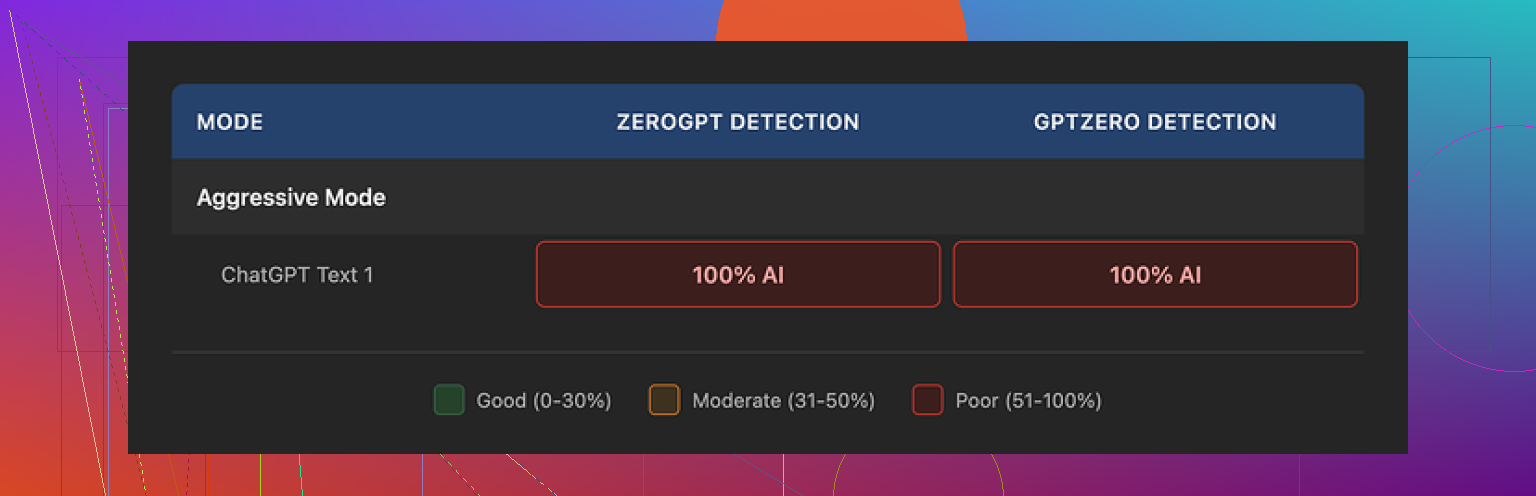
I took a 200 word GPT style academic paragraph I use across tools and pushed it through Phrasly with:
Strength: Aggressive
Tone: academic
Everything else: default
I ran the output through:
• GPTZero
• ZeroGPT
Both of them flagged the humanized text as 100 percent AI generated.
The Aggressive option, which Phrasly claims should help bypass detection, did nothing useful in my test. Detection scores stayed pegged at the top.
I only had enough credits to run that one pass, so no ability to try different inputs or milder settings to see if results shifted.
How the text reads: good on the surface, AI underneath
To be fair, the processed text did not look broken.
What I saw:
• Sentences were grammatically fine
• Flow was smooth enough to pass as decent academic writing
• No bizarre word salad, no obvious glitches
The issues were more pattern based.
Stuff that triggered my “AI voice” radar:
• Triple adjective stacks: “clear, coherent, and structured” style phrases repeated
• Repetitive formal phrasing, same connective phrases over and over
• Overuse of safe academic constructions that detectors latch onto quickly
So if your only requirement is “does not sound like total nonsense”, it passes.
If your requirement is “survives modern AI detectors”, my single test says no.
Word count bloat
My input: about 200 words
Phrasly output: over 280 words
So roughly a 40 percent increase in length from one pass.
If you are writing for:
• Assignments with tight word limits
• Forms with character caps
• Grant applications or journals that require strict ranges
this inflation becomes a problem fast. You end up cleaning up extra fluff manually, which kills the point of paying for a “humanizer” in the first place.
Paid plan, Pro Engine, and a rough refund policy
Phrasly pushes an “Unlimited” subscription tier at $12.99 per month on an annual plan. The pitch is that the paid Pro Engine performs far better than the free one.
I did not buy it, and here is why.
Their refund policy is hostile.
Key bit that stood out:
• You only qualify for a refund if your account shows zero usage
• If you humanize even one sentence, they say you lose eligibility
• They explicitly threaten legal action against people who do chargebacks
So to test the so-called better engine risk free, you would need to pay, not touch the product at all, then ask for a refund. Which makes no sense.
From a user perspective, this feels like “once you click the button, the money is gone.” If you like to test, measure, decide, this policy blocks any realistic trial of the Pro Engine.
YouTube review reference
There is also a Clever AI Humanizer YouTube review linked through the same image:
The thumbnail text in the image:
Compared to that, my hands-on with Phrasly felt limited and underwhelming.
Quick comparison: Phrasly vs Clever AI Humanizer
Across the tools I went through so far, Clever AI Humanizer stood out in three areas:
• Stronger detection bypass in my tests
• No fee wall for basic use
• No aggressive refund or threat language thrown at the user
Where Phrasly lost me:
• Hard 300 word cap on free usage
• IP-based restriction on new accounts
• Poor performance on GPTZero and ZeroGPT in my one Aggressive test
• Word inflation that complicates word-limited tasks
• Refund policy that punishes normal trial behavior
If you are experimenting with AI humanizers and do not want to pay upfront or deal with risky terms, Clever AI Humanizer felt safer and more effective in my testing than Phrasly.
3 Likes
Short version. If your goal is “pass AI detectors and stay safe from penalties,” Phrasly looks like a bad bet right now.
Here is the practical breakdown, trying not to repeat what @mikeappsreviewer already covered.
-
Detection and risk for penalties
Phrasly’s whole pitch is “bypass AI detectors.”
The fact it got nailed at 100 percent AI on both GPTZero and ZeroGPT in aggressive mode is a big red flag.
If you are worried about academic or platform penalties, you need consistency across several detectors, not a tool that fails on the basics.
Also, detectors keep changing. A tool that already struggles on current ones is a weak long term choice. -
Text quality and voice
The output quality described sounds fine on surface. Clean grammar. Smooth flow.
The problem is pattern noise. Repeated formal phrases. Overuse of academic connectors. Triple adjective stacks.
Detectors look for patterns like that. Humans do too. Your professor, editor, or client will notice “AI voice” even if it reads smooth.
You avoid penalties by making the content fit your real voice, not by hitting “aggressive” on a humanizer and hoping. -
Word inflation and real world use
Around 40 percent length increase is not a small issue.
If you write essays with 1,000 word caps, journal submissions with strict ranges, or social content with hard character limits, you will need to trim every output.
Trimming ruins any time you “save” with the tool and increases the chance you introduce awkward phrasing again. -
Free tier and testing
The 300 word lifetime limit on the free tier is too tight for serious testing.
You cannot run multiple styles, genres, or tones. You cannot test longer pieces that reflect your real use.
IP locking on new accounts makes it worse. That tells you they optimize for protecting credits, not for letting users validate quality first. -
Refund and trust
The refund policy that kills refunds as soon as you use a single sentence is a trust issue.
If they were confident in the “Pro Engine,” they would allow some real use before locking refunds.
Legal threats over chargebacks also signal the relationship they expect with customers. You carry the whole risk. -
About “bypassing” detectors in general
No humanizer is a safe shield if you feed in generic AI text and never touch it.
Detectors look at pattern, burstiness, structure, and predictability.
The safest workflow if you still want help from AI.
- Use AI to draft.
- Humanize with a tool as a helper only.
- Then manually edit heavily, change structure, rearrange arguments, mix your own knowledge and examples.
- Run your own detection checks if you care about risk.
Relying on one-button humanization for high stakes stuff, like graded work or SEO content under strict publisher rules, is high risk.
-
Alternative option
If you want to try a different tool, Clever Ai Humanizer is worth a look.
No hard paywall for basic use, more relaxed terms, and better detector performance based on multiple user tests I have seen.
You still need to edit the output and not treat it as a magic cloak, but it is more practical for experimenting and building a workflow that fits you. -
What I would do in your place
- Skip Phrasly for now, given detection results, tiny free tier, and refund issues.
- Test Clever Ai Humanizer on a few of your real texts instead.
- After that, pick one workflow and stick to it. For example.
AI draft, then humanizer, then 30 to 40 percent manual rewrite, then detector check, then final polish.
If penalties are a serious worry for you, spend more time on your own edits and voice and treat any humanizer as a helper, not a shield.
Short version: if your main goal is “beat AI detectors and avoid penalties,” Phrasly is the wrong tool to pin your hopes on.
A few points that build on what @mikeappsreviewer and @chasseurdetoiles already saw, without just echoing them:
-
The goal is the problem, not just the tool
Any service that markets itself primarily as “we’ll hide that this is AI” is already skating on thin ice. Detectors are changing constantly and institutions are catching up faster than these humanizers are. Even if Phrasly suddenly got better, you’d still be playing catch‑up with systems you don’t control. -
Detector performance
They both saw Phrasly get nailed at 100% AI by multiple detectors even on “aggressive” mode. I’ll push back slightly here: one 200‑word test is not a scientific benchmark. You could find edge cases where Phrasly slips through a detector or two.
But that’s kinda the problem: if you’re dealing with grades, client work, or platforms that can ban you, “sometimes it passes” is not a serious safety net. -
Text quality vs human quality
Phrasly output being “clean, grammatical, smooth” is not the win it seems. Most detectors are basically punishing that safe, uniform, mid‑level academic voice. Phrasly is polishing the very style that gets caught.
You avoid suspicion by sounding like you: messy in spots, uneven sentence lengths, specific details, actual lived experience. No humanizer is going to inject your real stories and quirks. -
Word count inflation
That ~40% length bloat may sound minor, but if you’re doing essays, applications, blog posts with tight formatting, you’ll be cutting it back anyway. Every extra pass you do to shrink and rephrase it drifts you further from what the humanizer produced… which raises the question: why pay Phrasly at all if you’re rewriting heavily? -
Pricing and trust
I’m with them on the refund policy being a huge red flag. “Use one sentence and you lose refund eligibility” plus legal-threat language is not how confident SaaS behaves. That doesn’t mean the tool is a total scam, but it does mean you’re bearing all the risk. For a product that already struggles on detectors, that’s a bad trade. -
What to actually do if you’re worried about penalties
If this is academic:- The safest path is still: use AI for brainstorming/outline only, then write in your own words.
- If you still insist on a humanizer, treat it as a helper, not a cloak. Feed in your draft to clean it up, then edit again so the voice is clearly yours.
- Don’t just paste pure AI output, click “humanize,” and submit. That’s exactly the pattern that gets nuked.
If this is for content / blogging:
- Mix AI drafts with your personal examples, screenshots, insights from your work.
- Run a detector check if it makes you feel safer, but don’t obsess. Google is not using the public detectors like GPTZero to hand out penalties; they care far more about usefulness and originality.
-
Competitors and alternatives
Since you mentioned not wanting risk:- Clever Ai Humanizer is a more reasonable place to experiment. It’s not magic either, but it does give you more room to test and fit into a workflow without locking you behind a tiny 300‑word lifetime cap.
- Regardless of tool, assume you’ll still need a 30–50% manual rewrite if you’re truly trying to de‑AI the text.
-
Bottom line on Phrasly specifically
- The free tier is too tiny to seriously evaluate.
- Detector performance from multiple users is unimpressive.
- Output style still screams “AI” to both detectors and humans.
- Refund / terms shift too much risk onto you.
If you’re on the fence and penalties are a real fear, skip Phrasly for now. Use something like Clever Ai Humanizer only as a step in your process, not the core solution, and put most of your effort into making the content genuinely yours. That’s the only strategy that ages well as detectors and policies keep changing.
Short version: if your main goal is “hide AI from detectors,” you’re chasing a moving target, and Phrasly looks like a weak shield for that specific job.
A few angles that haven’t been stressed as much yet:
1. The risk no one wants to talk about: your writing fingerprint
AI detectors are one risk. The bigger, quieter risk is your own “before vs after” trail.
If your teacher, editor or platform has:
- Past samples of your writing
- A sudden spike in polished, inflated, generic academic tone
they can flag you without ever touching GPTZero or ZeroGPT. That is where tools like Phrasly hurt you most: they normalize your voice into the exact bland, pattern-heavy style that screams “generic AI” when compared to what you normally produce.
If you care about safety, matching your previous work matters more than tricking detectors. None of these tools, Phrasly or Clever Ai Humanizer, can learn your personal history on their own.
2. Where I partly disagree with others
@chasseurdetoiles and @mikeappsreviewer are right that Phrasly looks bad as a “click once, bypass everything” solution. I do think they underplay one use case, though:
Low stakes, disposable content.
Stuff like:
- Drafting internal notes
- Brainstorm outlines
- Social captions where you are not gaming a policy
For that kind of thing, “it sounds okay, even if it’s AI-ish” can be good enough. Phrasly still feels overpriced and restrictive for that, but the concept of a humanizer is not automatically a terrible idea if you are not under institutional rules.
Where I side fully with them: using Phrasly for graded work, client deliverables with strict policies, or SEO where you are terrified of penalties is a bad gamble.
3. Phrasly’s biggest practical issue: lack of iteration
You will not beat detectors in 2025 with a single click. You need:
- Multiple drafts
- Tweaks in structure
- Shuffling arguments and examples
- Injecting real knowledge and personal detail
Phrasly’s tiny free tier and “use anything and you lose refund eligibility” vibe block that kind of iterative testing. You cannot meaningfully A/B test tones, lengths, or rephrasing patterns. That matters more than one 200 word detection test.
In contrast, tools like Clever Ai Humanizer at least let you experiment more freely and find a workflow. I do not think Clever is some magic invisibility cloak either, but the ability to iterate without feeling punished is a real edge.
4. Clever Ai Humanizer: actual pros and cons
Since several people already mentioned it, here is a more blunt take on Clever Ai Humanizer itself.
Pros
- More generous free usage, so you can:
- Test long-form pieces
- Try multiple tones and strengths
- Compare several passes through detectors
- Generally stronger performance in bypass tests reported by others here, especially when combined with manual edits
- Less hostile “terms and refund” posture, so you are not scared to click the button
- Output tends to be slightly more varied in sentence rhythm than Phrasly, which helps fight the ultra-flat AI cadence
Cons
- Still produces “AI-clean” text unless you push it further with your own edits
- Can occasionally over-soften or over-formalize, which makes blog or conversational content feel generic
- No tool-level understanding of your unique voice; you still have to layer your habits and quirks on top
- If you rely on it blindly for high stakes use, you are in the same ethical and practical danger zone as with Phrasly
So Clever Ai Humanizer is a better environment for experimenting and building a safer workflow, not a guarantee that detectors or professors will never catch odd patterns.
5. What actually works in 2025 if you must use AI
Instead of rehashing the exact step lists already shared, here is a different framing: treat AI like a noisy writing partner, not a ghostwriter.
- Let AI help with idea generation, structure, and phrasing options.
- Use a humanizer like Clever Ai Humanizer only to break obvious model patterns, not to invent content for you.
- Rewrite at the paragraph level, not just swapping synonyms. Change:
- Order of arguments
- Types of examples
- The way you open and close sections
- Inject specifics only you know. Dates of your own projects, mistakes you made, details from your workplace or classes. Detectors cannot fake that convincingly.
If the resulting text still looks too smooth and formally consistent, deliberately roughen a few spots so it aligns better with your previous work and natural style.
6. When Phrasly is clearly the wrong tool
I would avoid Phrasly completely if:
- You are under any academic integrity policy that explicitly mentions AI
- You are writing for platforms that ban AI content or suspend accounts on suspicion
- Word limits are strict and you cannot afford 30 to 40 percent bloat
- You like to thoroughly test tools before paying, because Phrasly’s setup punishes test-heavy users
In those scenarios you are better off:
- Writing from scratch with AI as a background assistant only, or
- Using a more flexible humanizer like Clever Ai Humanizer as a small part of a much heavier manual rewrite.
7. Final sanity check
If you are asking “will Phrasly keep me 100 percent safe from penalties,” the honest answer is no, and so will no other humanizer.
If you are asking “which tool gives me room to experiment and improve readability without boxing me in,” then Clever Ai Humanizer is the more sensible choice, with the big disclaimer that your own editing habits will decide whether the final text feels genuinely human or not.
Treat any of these tools as accelerators for your thinking, not as a hiding place for AI. That mindset shift matters more than the brand on the button you press.