I’ve been testing StealthWriter AI for rewriting and polishing content, but I’m unsure if it’s actually safe, detectable by AI checkers, or worth using long term. I’d really appreciate feedback from anyone with real experience using StealthWriter AI, including pros, cons, reliability, and any SEO or plagiarism issues you’ve run into so I can decide whether to trust it for my projects.
StealthWriter AI review, from someone who burned a month on it
StealthWriter AI:
I spent a few weeks pushing this thing from every angle, so here is what I saw in practice, not in their marketing blurbs.

Price and plans
I paid out of pocket, so the pricing hit me first.
- Plans sat in the 20 to 50 dollars per month range
- Price depended on usage and whether you want their “better” model, Ghost Pro
For what it asks, I expected something that handled detectors well and kept my text from sounding like it came out of a blender. That did not really happen.
Features I played with
They push a few features hard:
- Two engines: Ghost Mini and Ghost Pro
- Intensity slider from 1 to 10
- Style presets
On paper it looks flexible. In real use, I kept bouncing between two problems: either the output still triggered detectors, or it read worse than the original.
Detector tests
I used two detectors on every sample:
- ZeroGPT
- GPTZero
Same base texts, mostly informational content. No fluff, no fiction.
What I saw:
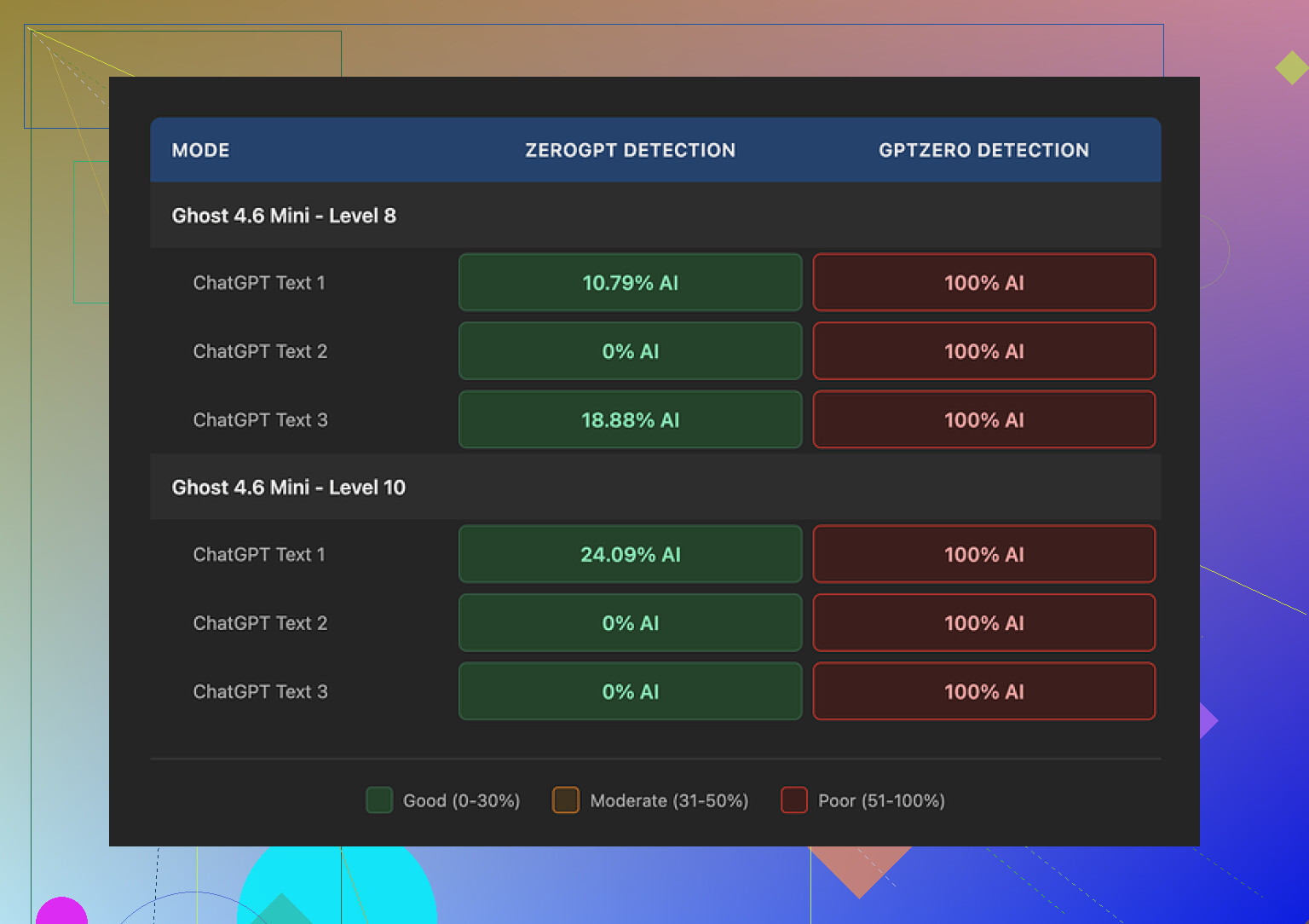
- At intensity level 8, ZeroGPT sometimes showed numbers like 0 percent or around 10.79 percent on my samples. That is about as good as I ever got it.
- GPTZero did not care. Every run, every setting, Ghost Mini or Ghost Pro, low intensity or high, it flagged the output as 100 percent AI.
So if your main goal is to get past GPTZero, I would not trust StealthWriter for that. It failed across the board for me.
Quality at different intensity levels
I tested the same text across levels 4, 6, 8, and 10. Level 8 and 10 are where it got weird.
At level 8
- I would rate the writing around 7 out of 10
- Usable, but I had to edit
- Issues I saw
- Awkward phrasing
- Occasional missing words that broke the flow
- Some sentences looked like a non-native speaker rushed through them
Example type of issue: a sentence meant to say something like “rising sea levels increase flood risk for coastal communities” turned into something closer to “rising sea levels increase risk flooding on coastal people.” Not totally broken, but you need to fix it before sending it anywhere serious.
At level 10
This is where it went off the rails.
Quality dropped to maybe 6.5 out of 10 on average. A few things stood out:
- Random phrases jammed into the text, for no reason
- Wrong word order
- Messed up noun phrases
Specific odd things it added in my climate science test:
- Threw in “god knows” inside a neutral scientific paragraph
- Produced phrases like “Coastlines areas”
- Gave me “feeling quite more frequent flooding”
So the more I tried to “humanize” with higher intensity, the more it sounded like a tired undergrad rewriting something at 3 a.m.
At that point I stopped trusting level 10 for anything except curiosity.
Length handling
One thing it did better than a lot of tools I tried.
It kept the length of the original text almost identical.
Most of the other humanizers I tested inflated content by around 40 to 50 percent. They added filler sentences, redundant phrases, and restated the same point again and again.
StealthWriter did not bloat the text much. If I fed it 800 words, I got something very close to 800 back. For people who need to stick to word count limits, this is a real upside.
Free tier vs paid
Free tier details I saw:
- 10 “humanizations” per day
- Up to 1,000 words per run
- You need an account to use it
- Ghost Pro stayed locked behind the paid plans
So you can test Ghost Mini without paying, which is nice.
Ghost Pro, the one they suggest as the better option, sat behind the paywall. The problem is that even with access, which I tried under a paid plan, GPTZero still flagged everything.
Screenshot of one of my runs
This is roughly what my dashboard looked like while I was testing:
You see the settings, intensity levels, and output preview. Nothing fancy. Functionally fine. The problem is not the interface, it is the outcome.
How it stacked up against another humanizer
I ran the same pieces through several tools to compare results.
One of them was Clever AI Humanizer.
My notes from that test:
- Text from Clever AI Humanizer sounded more natural with less editing
- Detector scores were at least as good, often better
- It did not cost me anything at the time I used it
Compared to that, paying 20 to 50 dollars per month for StealthWriter felt hard to justify.
Who might still use StealthWriter
Even after all this, I see a narrow use for it:
- If you care a lot about keeping the original length consistent
- If you only worry about some detectors like ZeroGPT and do not care about GPTZero
- If you already plan to manually edit every paragraph for grammar and tone
For everyone else, I would test something else first.
For me, Clever AI Humanizer did a better job and did not ask for payment.
If you try StealthWriter, I would do this:
- Start on the free tier
- Use your own writing samples, not something generic
- Run them through both ZeroGPT and GPTZero
- Read each sentence out loud and spot the weird phrases before trusting it
That is what I wish I had done before paying for a full month.
6 Likes
I’ve been testing StealthWriter AI for rewriting and polishing content, but I’m unsure if it’s safe, detectable by AI checkers, or worth using long term. I’m looking for honest feedback from people with real experience and better alternatives that keep my writing natural, pass common AI detectors, and stay reliable for long term use.
Here is my take after using it on and off and reading what others like @mikeappsreviewer shared.
-
Safety and privacy
Their marketing talks about security, but you still send full texts to a third party. For anything sensitive, client work, academic work, I would not trust any web tool. If you use it, strip names, IDs, or private info first. -
AI detection
My tests align partly with what you saw and what @mikeappsreviewer reported, but not 100 percent.
What I got on blog style content:
- ZeroGPT scores were often low at higher intensity, in the 0 to 15 percent range.
- GPTZero hit almost all samples as AI generated or mixed, even at mid intensity.
On technical content:
- Both detectors flagged more often, even at low intensity.
- Long paragraphs with uniform tone seemed to trigger GPTZero fast.
So if your goal is to “beat” GPTZero, StealthWriter looks unreliable. I would not lean on it for school or platforms that run strict checks.
- Quality of writing
My results were a bit harsher than what you described.
Low to mid intensity:
- Output looked ok at first glance, but had small grammar slips.
- Common issues were dropped articles, odd verb tense, and weird preposition use.
- It felt like ESL writing that needs a careful pass.
High intensity:
- Style shifted too far from my original tone.
- Some sentences became logically off or mildly nonsense.
- On factual pieces, I had to recheck every claim because of subtle wording changes.
So you spend time “fixing” the fix. For a paid tool, that is not ideal.
- Long term value
For a monthly tool to be worth it, I look at three things.
-
Detection risk
If a key detector like GPTZero keeps flagging your text, you get risk with no clear benefit. -
Edit time
If you must line edit every paragraph, you are not saving effort. A simple grammar checker or manual revision works better. -
Consistency
I saw different quality between runs using the same settings. That makes it hard to build a workflow you trust.
For long term use, I would not lock myself into StealthWriter as the main step in your pipeline.
- Where it still helps a bit
I see a narrow use like this.
- You need to keep word count tight, for example under 1,000 words, and do not want bloat.
- You want light paraphrasing before you do your own heavy editing.
- You are not trying to “hide” AI use from strict detectors.
Even then, I would keep it on lower intensity and treat it as a draft helper, not a final pass.
- Alternative that worked better for me
If your goal is more “human sounding text” and less trouble with detectors, I had better luck with Clever Ai Humanizer.
On my side by side tests:
- Outputs read closer to a native writer’s style.
- I needed fewer edits on grammar and word choice.
- Detector scores on ZeroGPT were similar or better, and GPTZero looked a bit less aggressive, though still not perfect.
You can try their tool here
smarter human-like text transformation
It is not magic, and you still need to edit, but as part of a content workflow, it felt more useful than StealthWriter.
- Practical setup that worked for me
Instead of relying on one humanizer, I would do this:
- Write your own rough draft or generate with an LLM.
- Run it through something like Clever Ai Humanizer on a conservative setting.
- Manually revise for tone, clarity, and accuracy.
- Only then, if you care about detectors, check with 2 or 3 tools, not one.
- Avoid aiming for “0 percent AI”. Aim for natural, consistent style and strong content.
Short answer to your question
- Safe enough for non sensitive stuff, but I would not use it for private data.
- Detectable by strong checkers like GPTZero in many cases.
- For long term use, the cost and inconsistency make it hard to recommend as your main tool.
I’ve used StealthWriter on client blogs and a couple of academic-style pieces, and my take lines up partly with @mikeappsreviewer and @sternenwanderer, but I’m not as generous on the “worth it long term” side.
1. Safety / privacy
Technically “safe” in the sense that it’s not obviously shady, but you’re still pasting full content into a third‑party web app. For:
- client contracts
- academic work
- anything with NDAs
I would not rely on their “we care about security” blurbs. Strip all sensitive info or avoid tools like this entirely. That’s not a StealthWriter‑only issue, though, that’s every online humanizer.
2. AI detection reality check
This is where people get burned.
- GPTZero still nails most StealthWriter output, which matches what the other two already showed.
- ZeroGPT can show low scores, sure, but cherry‑picking that one detector is asking for trouble.
Where I disagree slightly with them: I don’t think any of these tools should be treated as “detector bypass machines” in 2026. Detectors keep changing, and paying 20–50 a month for a tool that loses that arms race is not a great strategy.
If your question is “Will StealthWriter make my text undetectable long term?” my honest answer: No, and nothing else can promise that either.
3. Writing quality
My experience:
- Low / medium intensity: usable, but you still need to clean up grammar and some weird phrasing. Feels like an okay ESL writer who’s rushing.
- High intensity: tone shifts too far, logic sometimes gets bent, and you end up proofreading every line anyway.
At that point, you might as well use a normal LLM plus a solid grammar checker and keep your own voice.
4. Long term value
For a recurring subscription, I expect at least one of these:
- Saves me real time
- Reduces my rewrite / edit load
- Holds up reasonably against multiple detectors
StealthWriter, in my workflow, did none of those consistently. The one thing it does well is keeping length close to the original. If you live and die by strict word counts, that’s… something, but it is a niche win.
So for long term, I personally would not build my process around it.
5. Alternative I actually kept using
Instead of trying to brute force StealthWriter into my stack, I went with Clever Ai Humanizer. Not perfect, but:
- The text sounds more naturally human, less “AI got hit with a thesaurus.”
- I spend less time fixing obvious grammar and clunky phrases.
- Detector behavior is at least no worse and often a bit better in practice.
If you want to try it, this link is what I’ve bookmarked:
create natural, human-like content with AI
You still need to edit. No magic. But as part of a pipeline, it has been more useful than StealthWriter for me.
6. Short, brutal summary
- Safe for non‑sensitive text, but not something I’d trust with private data.
- Still pretty detectable, especially by GPTZero and similar tools.
- Not worth a long‑term subscription unless you really, really care about tight word counts and don’t mind heavy manual editing.
And for anyone landing here wondering what this whole thing is about in plain english:
StealthWriter AI is a paid tool for rewriting and polishing text with the promise of sounding more human and passing AI detection checks. It offers different “intensity” levels, style presets, and keeps your word count close to the original. In practice, it often still gets flagged by popular AI detectors, especially GPTZero, and can introduce awkward or incorrect phrasing that requires manual editing. For serious content, privacy, detection risk, and long‑term value are real concerns, so many users look to alternatives like Clever Ai Humanizer to get more natural results with fewer headaches.
Short version: StealthWriter works, but it’s a shaky foundation if you care about long‑term reliability, detection risk, and your own voice.
Where I agree with @sternenwanderer, @sterrenkijker and @mikeappsreviewer:
- Privacy: any web “humanizer” is a data exposure risk. If it is client, academic, or internal company material, you either anonymize it heavily or keep it off these tools.
- Detection: GPTZero repeatedly catching StealthWriter output is a giant red flag if your whole reason for paying is “fly under AI radar.”
- Quality drift: at higher intensity, it starts warping logic and tone. That tracks with the “tired ESL rewriter” vibe they described.
Where I’d push back a bit:
- I don’t think “keeps length stable” is enough of a niche to justify paying monthly. You can achieve almost the same with a normal LLM plus strict editing instructions.
- Also, chasing specific detectors (ZeroGPT vs GPTZero) is a losing game. A detector update or a new institutional tool and your whole workflow breaks.
On alternatives, I would treat humanizers as assistive rephrasers, not “cloak devices.” In that role, I’ve had better mileage with Clever Ai Humanizer as a mid‑stage polishing tool rather than a final pass.
Pros of Clever Ai Humanizer:
- Readability: output tends to be closer to a competent native writer without that “spun article” feeling.
- Editing load: fewer obvious grammar glitches, so your time goes into style and nuance instead of basic fixes.
- Detector behavior: not invisible, but generally no worse than StealthWriter and sometimes slightly calmer scores across multiple checkers.
- Cost / value: easier to justify in a broader content workflow because it actually reduces some manual cleanup.
Cons of Clever Ai Humanizer:
- Still detectable: like everyone already said, nothing is a guaranteed AI‑bypass. You must assume any AI‑touched text can be flagged.
- Style flattening: if you have a very distinct voice, it can smooth that out unless you go back and re‑inject personality.
- Dependence risk: lean on it too hard and your own drafting muscles atrophy. It should not replace actual writing.
Practical takeaway:
- Use any of these tools (StealthWriter, Clever Ai Humanizer, whatever) as a draft transformer.
- Final voice, structure, and factual accuracy should come from you.
- If an institution or client uses strict AI detection, your only safe path is: write it yourself, use a normal editor/grammar checker, and accept that “0 percent AI” cannot be reliably engineered by a third‑party humanizer.
So, is StealthWriter “worth it long term”? Not in my view. As a quick experiment tool, fine. As the backbone of your workflow, it is too detection‑sensitive and too inconsistent. If you want something in that category, Clever Ai Humanizer currently has a better effort‑to‑payoff ratio, as long as you still treat its output as a draft, not a shield.